In twin-screw compounding, when pigment specks, filler agglomerates or a failed dispersion test show up, one of the first adjustments on the line is often to raise the screw speed.
There is a reason for it: on the same extruder with the same screw configuration, a higher speed usually raises the local shear rate and can intensify dispersive mixing.
The results are not always the same, though. On some formulations dispersion clearly improves. On others the main effect is a hotter melt. On others still the dispersion test improves while product properties start to fall.
So the real question is not whether the speed can go up. It is whether the cause of the poor dispersion is one that a speed change can fix, and what that improvement costs.
This guide covers the dispersion of pigment and filler agglomerates in co-rotating twin-screw compounding. Fiber length retention and morphology control in polymer blends are different tasks and are not treated as the same problem.
Higher screw speed may improve dispersion, but not for every formulation. It changes the local shear rate, melt viscosity, fill level and residence behavior at the same time. Whether it works has to be verified under comparable conditions, against the actual melt temperature, the machine load, a dispersion test and the key product properties
01Poor Dispersion or Poor Distribution?
"It isn't mixed well" can describe more than one problem.
Dispersive mixing is about whether agglomerates are fully wetted and broken down. If a pigment or filler is still present as large agglomerates, it needs the right stress and the right process to disperse.
Distributive mixing is about whether the components are spread evenly through the material. Where the local concentration varies, color or properties can be inconsistent even without visible large agglomerates.
The two are linked, but one observation cannot tell them apart.
A color difference does not always come from poor dispersion; metering fluctuation, raw material lots or process changes can cause it too. Pellets with a smoother surface do not prove on their own that there are fewer agglomerates inside.
Before changing the speed, therefore, decide which result has to improve and how it will be measured.
02Why Higher Screw Speed Can Improve Dispersion
As the screws turn, the material goes through complex flow in the conveying, kneading and clearance zones. A higher speed usually steepens the velocity gradient in some of these zones and raises the local shear rate.
If the material has already melted and been wetted, and what is missing is the mechanical action needed to break the agglomerates, a moderate increase in speed can improve dispersion.
Whether an agglomerate breaks does not depend on the shear rate alone. It also depends on the stress the material sees, the strength of the agglomerate itself, and how the material passes through the effective mixing zones.
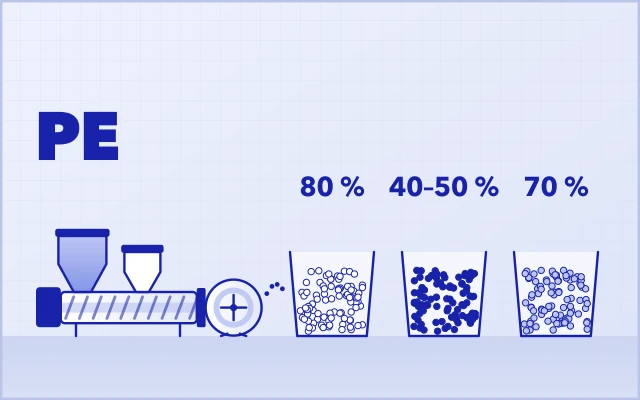
Published trials on carbon black masterbatch, for example, show that both screw speed and screw configuration affect the dispersion result, each with a different rise in melt temperature. Results like these support the idea that a higher speed can help; they do not mean every material should run faster.
03A Higher Shear Rate Does Not Mean Proportionally Higher Shear Stress
A simplified relation helps here:
Local shear stress ≈ local apparent viscosity × local shear rate
It explains local shear flow; it does not replace an analysis of the complex flow field inside a twin-screw extruder.
Polymer melts are usually non-Newtonian. As the shear rate rises, the apparent viscosity can fall, and the temperature rise from mechanical heating can lower it further.
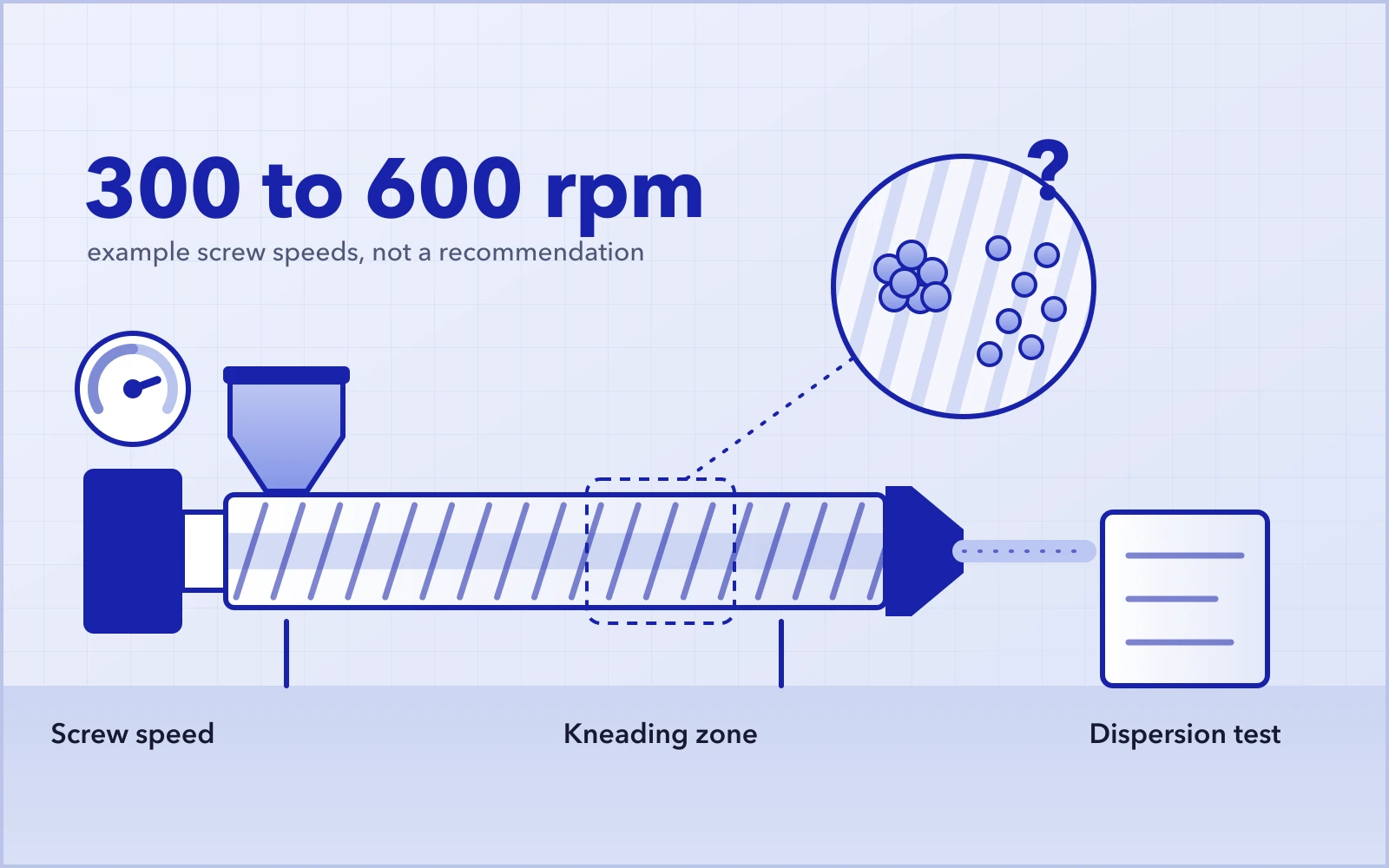
So going from 300 to 600 rpm may raise the shear rate sharply in some places, yet the shear stress cannot simply be taken as doubled.
A lower viscosity does not necessarily mean a lower shear stress either. The net change depends on the rheology of the material, the temperature and the local flow conditions.
For dispersion, what matters is whether the material sees a stress high enough to break the target agglomerates, and whether that action is sufficient. A faster screw is only one of the conditions.
04Higher Screw Speed Also Changes the State of the Material in the Extruder
Fill Level May Change
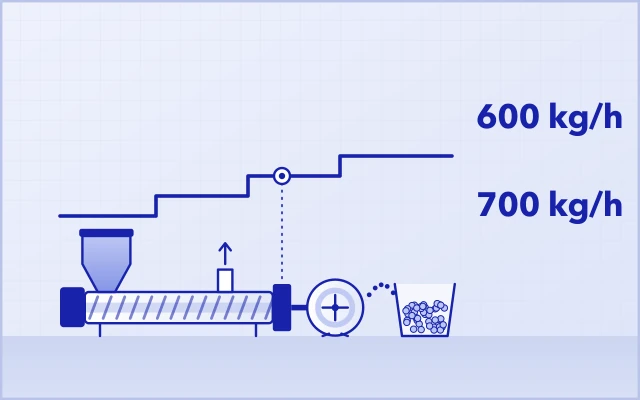
With starve-fed metering at a constant feed rate, a higher screw speed changes the feed per revolution, and the fill level in some conveying zones may drop.
But a twin-screw extruder is not filled to the same degree from end to end. Kneading blocks, reverse elements and downstream restrictions shape the local fill and pressure profile.
"The speed went up" alone does not show that there is less material along the whole screw, or that every mixing zone works harder.
Residence Behavior May Change
At a higher speed the mean residence time may get shorter, but the actual change also depends on the feed rate, the screw configuration and the local fill.
Dispersion depends on the stress the material sees, how long it acts and the flow path. Stronger local action does not mean that every portion of material receives proportionally more mixing in total.
Actual Melt Temperature May Change
Unchanged barrel setpoints do not mean an unchanged material temperature.
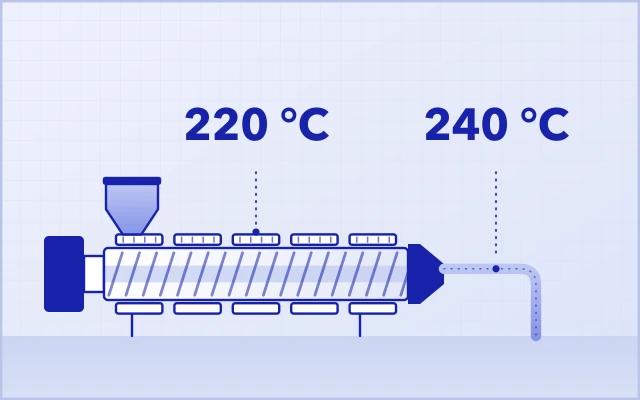
Once a speed change alters the mechanical energy input and the heat transfer, the melt temperature can rise. A moderate rise sometimes helps melting, wetting and flow; beyond the processing window of the material it can cause degradation or a loss of properties. See why the melt temperature can run above the barrel setpoint.
So when judging a speed change, record the actual melt temperature, not just the controller setpoints.
05How to Test Whether a Higher Screw Speed Works
Establish a Stable Baseline
Choose a condition that currently runs stably and record:
- Formulation, raw material lots and drying condition;
- Screw configuration, feed positions and actual feed rate;
- Screw speed, barrel temperature setpoints and cooling status;
- Actual melt temperature, main motor load and die pressure;
- The current dispersion result and key product properties.
The baseline should cover a period of stable production, not one momentary reading.
Decide What the Trial Has to Answer
To find out whether a higher speed helps in itself, the first round should keep the formulation, raw material condition, feed rate and other controllable conditions the same, and raise only the speed, in small steps.
If speed and feed rate go up together, the trial answers a different question: whether the new operating point meets the specification. The result cannot be credited to speed alone.
Both trials are useful, but their aims differ, so do not mix their conclusions.
Sample Only After the Process Has Stabilized
After each change, wait for the process to settle again and make sure the material from the previous condition has been fully purged, then sample the same way each time.
There is no single waiting time for every extruder. Residence behavior, machine size and process layout differ, and so do the times needed to stabilize and purge.
Where possible, repeat the baseline condition to check whether raw material changes, the thermal state of the machine or drift over time have skewed the comparison.
Compare the Same Result with the Same Method
The dispersion test should match the application, for example:
| Product or Task | Possible Test | Watch Out For |
|---|---|---|
| Pigment or carbon black dispersion | Agglomerate size and count, microscopic dispersion rating | Keep sample preparation, field of view and counting method the same |
| Specific masterbatch applications | A suitable filter pressure rise or filter pressure value (FPV) test | Die pressure on the production line does not replace a dedicated dispersion test |
| Filled compounds | Agglomerates, uniformity of distribution and specified properties | Pellet appearance does not show the internal state |
| Systems sensitive to structure retention | Dispersion together with structure and property tests | Avoid improving dispersion while damaging fibers or other functional structures |
The actual tests and pass limits follow the customer's requirements and the applicable methods; do not carry them over from one material to another.
Check Temperature and Properties at the Same Time
Main motor current or torque shows a change in load, but it does not prove better dispersion on its own and does not replace product testing.
If you compare specific mechanical energy (SME), use the same basis for the power figure and the actual mass flow rate. SME shows the mechanical energy input per unit of material; it does not show where, or how, that energy acts on the material.
However many process parameters are recorded, the deciding question is still whether the product meets the specification.

06How to Read the Results of a Speed Change
| Result | What It Tells You | Next Step |
|---|---|---|
| Better dispersion; temperature and key properties within limits | The speed change is worth using at this operating point | Verify stability and repeatability in continuous operation |
| Higher melt temperature, dispersion about the same | The speed change brings little | Check wetting, plasticizing, feed positions and screw configuration |
| Better dispersion, but key properties fall | Better dispersion alone does not make the change a success | Check for overprocessing or damage to the material's structure |
| Dispersion and other results keep fluctuating | Other factors may be skewing the comparison | Stabilize metering, raw material condition and sampling first |
These results point to the next step; they do not diagnose the root cause from a distance. If a temperature rise and a loss of properties appear together, for example, verify the link between them before concluding from the correlation alone that the material has degraded.
Run every speed trial within the limits of the machine and the material. When a specified torque, pressure, temperature or product-quality limit is reached, follow the plant's procedure; do not keep running to finish the trial.
07What to Check When a Higher Speed Brings No Gain
When a speed change does not improve dispersion, stop treating speed as the only variable.
First, check whether the raw materials are fully wetted and plasticized. The state of the material as it enters the mixing section affects everything downstream. Unstable metering or poor wetting cannot always be made up for with more speed.
Next, check the feed positions. Once a component enters the extruder, does it get enough of the right processing length? Has a suitable melt formed before the point where dispersion is needed?
Then review the screw configuration: the position and type of the mixing elements and how they relate to the conveying elements around them, rather than simply adding more kneading blocks.
Finally, go back to the formulation. The surface condition of the filler, how the pigment agglomerates, the compatibility of the carrier with the base polymer and the dispersing aids can all change how hard dispersion is. Machine settings cannot replace a formulation that fits the process.

FAQs
Does a higher screw speed always improve dispersion in a twin-screw extruder?
No. It usually raises the local shear rate, but it also changes viscosity, fill level, residence behavior and melt temperature. It helps when the material is already melted and wetted and the missing piece is mechanical action; it helps little when the limit is wetting, metering, feed position, screw configuration or the formulation.
If the screw speed doubles, does the shear stress double?
No. Local shear stress is roughly apparent viscosity times shear rate, and polymer melts thin with shear and heat. The net change depends on the material's rheology, temperature and the local flow, so it cannot be taken as proportional to speed.
How should a screw speed trial be run?
Start from a stable baseline, keep the formulation, raw material condition and feed rate the same, raise only the speed in small steps, wait for the process to stabilize and purge before sampling, and compare the same dispersion test, the actual melt temperature and the key properties each time.
The melt got hotter but dispersion did not improve. What next?
Stop raising the speed. Check wetting and plasticizing, metering stability, feed positions, the mixing elements in the screw configuration, and the formulation itself: filler surface, pigment agglomerates, carrier compatibility and dispersing aids.
Conclusion
The Right Screw Speed Is the One That Meets the Specification, Not the Highest One
Raising the screw speed is one way to improve dispersion that can be verified, but it is not a universal answer.
The sound approach is to define the dispersion target first, change the speed in small steps under comparable conditions, sample once the process is stable, and judge the dispersion result, the actual melt temperature and the key properties together.
The speed worth running is not the highest one the extruder can reach. It is the operating point that, at the target output, steadily meets the dispersion, property and operating requirements.
This guide supports process judgment on the line; it does not replace trials with your formulation. The figures are schematic: they are not simulations, measured curves or performance promises, 300 and 600 rpm are examples rather than a recommended speed range, and the screws are simplified drawings, not actual element geometry.
If you are assessing dispersion on a twin-screw extruder or adjusting the process, send USEON the material and formulation range, screw configuration, screw speed, actual feed rate, melt temperature and dispersion test results. Complete operating data helps tell whether the problem lies in the speed setting, the process layout or the formulation. See USEON lines for color masterbatch and filler masterbatch, and the co-rotating twin-screw extruders.