
Lab Twin Screw Extruder
The laboratory extruder is specially designed for the trial-level or entry-level user, or for the small scale production of color masterbatch and some additive masterbatch. Its modular design makes it very flexible against different recipes.
- Compounding
- Direct extrusion
- Devolatilization
- Reaction extrusion
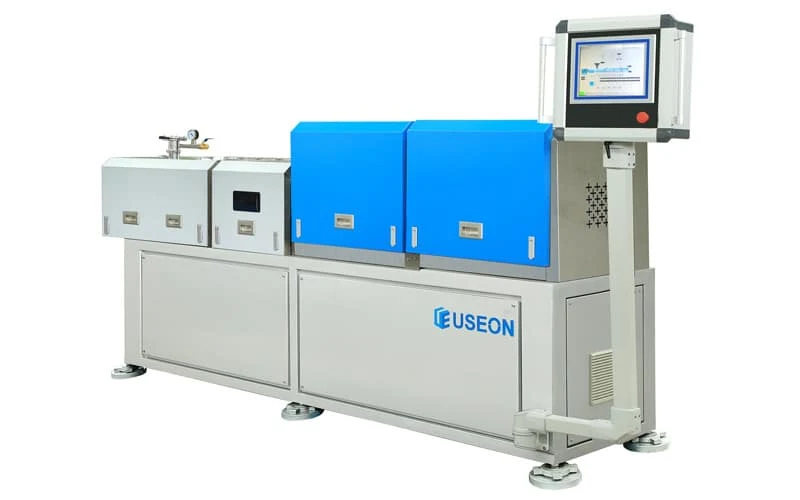
- Screw diameter, Lab-20 to Lab-35
- 22–35.6mm
- Process length
- 32–64L/D
- Output, by size and material
- 5–60kg/h
What a lab extruder is for
It simulates the continuous extrusion process on a small quantity of material.
Batch samples
Samples of a formulation, made on a continuous process.
New material research
Compounding, direct extrusion, degassing (devolatilization) and reaction extrusion on one machine.
New process development
A big range in screw geometry and screw speed.
Small quantity production
Color masterbatch and some additive masterbatch in small lots.
Machine design and control
A typical lab line
The extruder is usually delivered with feeding and a small pelletizing system.
- Premixing
- Lab twin screw extruder
- Filter
- Die plate
- Cooling
- Strand pelletizer
- Classifier
Side feeder
For powders and fibres, such as jute fibre powder into PE / PP.
Water bath
Water cooling strand pelletizing, as on the fluoroplastics line.
Air-cooled belt
Belt conveyor with air cooling, as on the cellulose acetate line.
Underwater
Underwater pelletizing for micro pellets, 30 kg/h on PS.
Lab series specifications
Three sizes. The last column shows lines we have delivered on each size.
| Model | Diameter (mm) | Max. Speed (rpm) | L/D | Motor (kW) | Output (kg/h) | Delivered lines |
|---|---|---|---|---|---|---|
| Lab-20 | 22 | 720 | 32–64 | 7.5 | 5–20 | Fluoroplastics compounding10 kg/hPE / PP + jute fibre powder10–20 kg/h |
| Lab-30 | 30 | 600 | 32–64 | 18.5 | 15–40 | PA66 + 45% glass fibre30–50 kg/hColor masterbatch line, Turkey |
| Lab-35 | 35.6 | 600 | 32–64 | 18.5 | 25–60 | Cellulose acetate + PEG50 kg/hPS micro pellets, underwater30 kg/hPPO + 25% fibre |
Output depends on the material and the formulation. Longer barrels are built for special processes: the two-stage devolatilization line below runs L/D 74 and L/D 58.
From the lab to production
The lab series uses screw elements that are geometrically similar to the production platforms, enabling reliable scale-up (not 1:1 identical).
Lab
Lab series
22–35.6 mm, 5–60 kg/h. Formulation and process development.
Production
SAT series
41–130 mm, 150–3,500 kg/h. Most compounding tasks.
SAT SeriesHigh torque
U+ series
27–93 mm. The series starts with the U2 Lab, 27 mm, for high-torque trials.
U+ Series- Co-rotating
- Counter-rotating
Project · LAB35 + LAB30 · pilot line
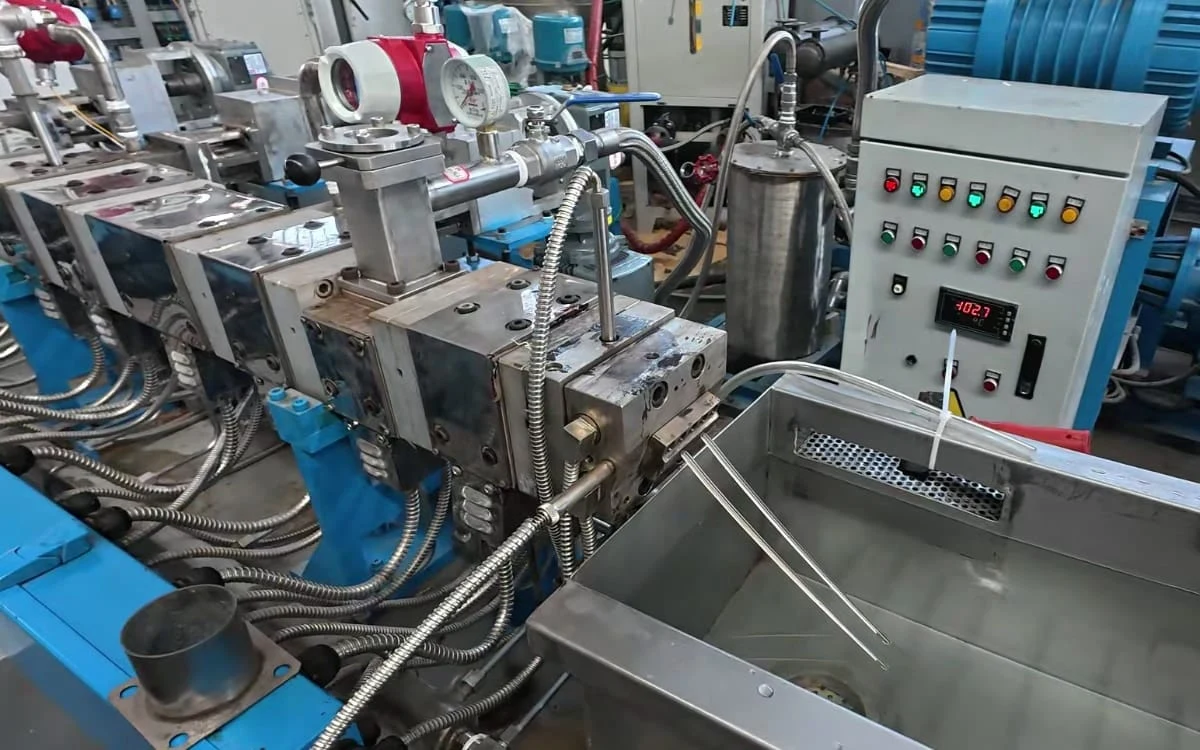
Two lab extruders in series for washing and devolatilization
A chemical company in East China needed a pilot line for a specialty polymer that requires continuous washing, extraction and devolatilization in a corrosive environment.
L/D 74. Primary reaction and washing zone, with three high-pressure liquid injection systems (up to 15 MPa).
L/D 58. A combined L/D of more than 130 D for residence time and solvent removal.
More lab projects
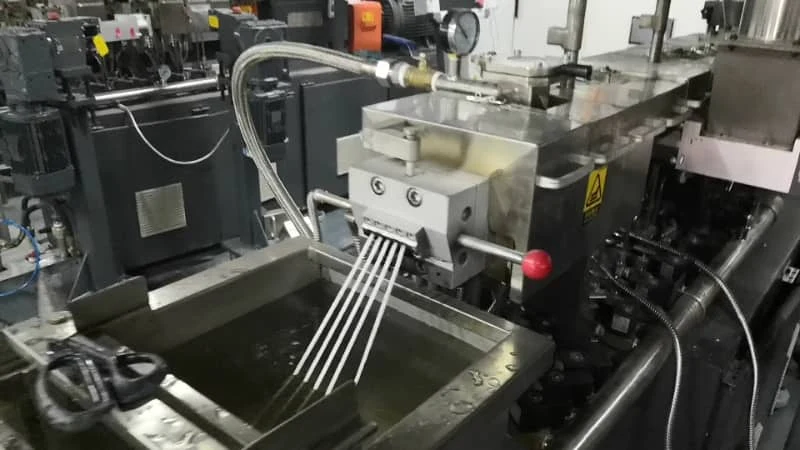 LAB-30
LAB Twin Screw Extruder for PA66 Compounding with 45% Glass Fiber
LAB-3030–50 kg/h
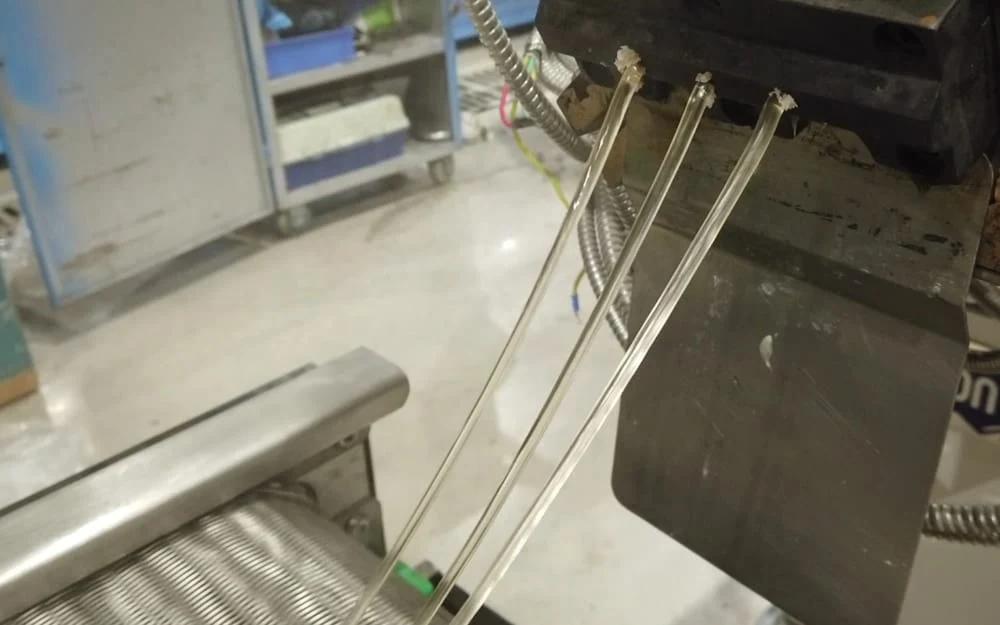 Lab35
Lab35 Twin Screw Extruder for Cellulose Acetate Compounding with PEG
Lab3550 kg/h
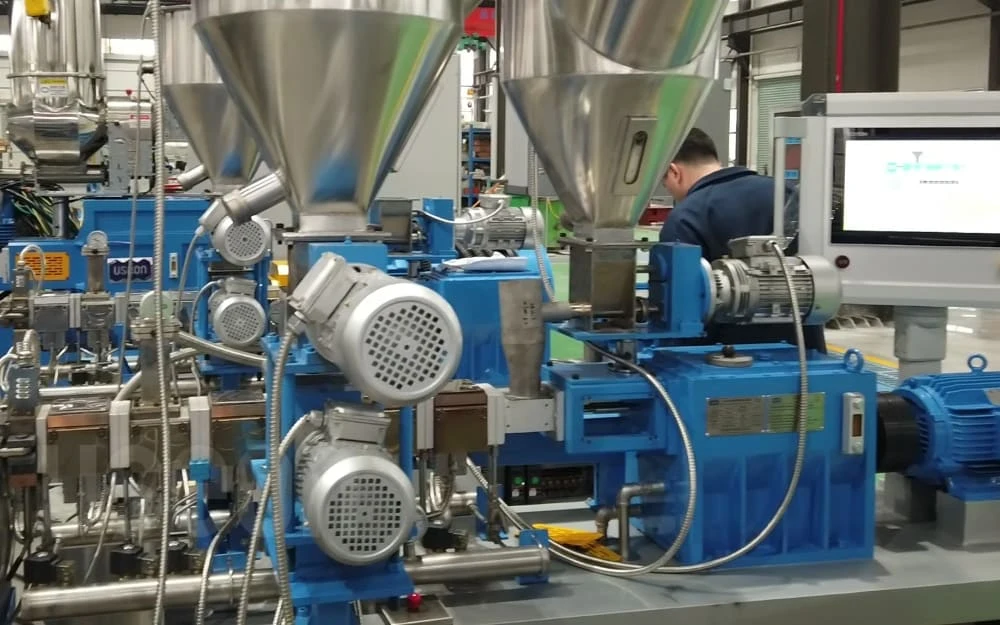 Lab20
Lab Extruder for Fluoroplastics Compounding
Lab2010 kg/h
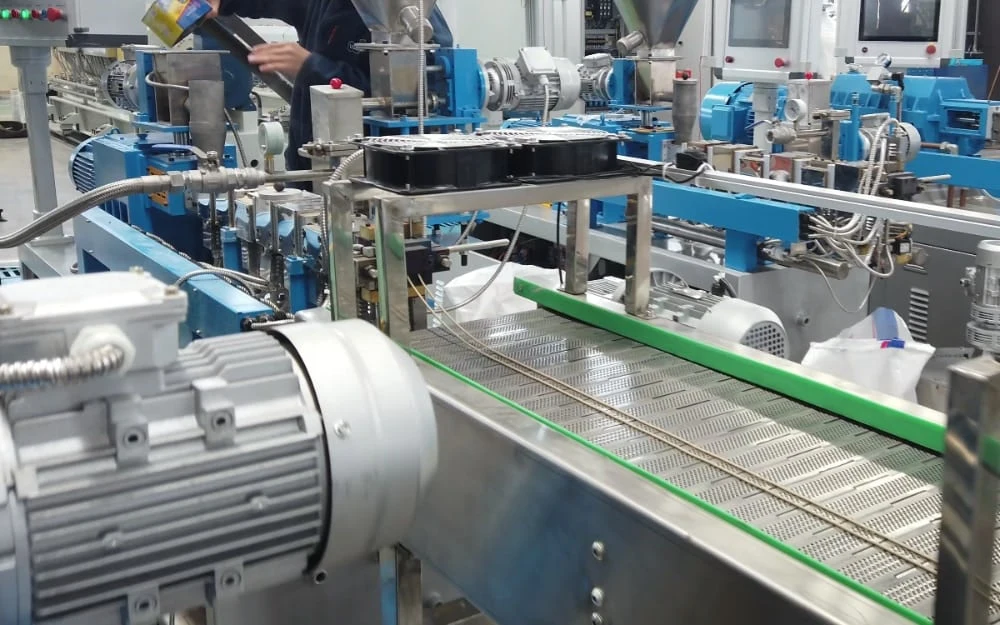 Lab20
Lab20 Extruder for PE/PP Compounding with Jute Fiber Powder
Lab2010–20 kg/h
Tell us the materials you want to test and what the trials are for. We propose the lab size, the L/D and the downstream equipment.
- 01Materials, and whether the line is for R&D or small production
- 02Quantity per trial and pelletizing method
- 03Lab size, L/D, configuration and quotation

Souder Chen
Head of Compounding Division
With USEON since 2008. Twin screw compounding, devolatilization and recycling lines.