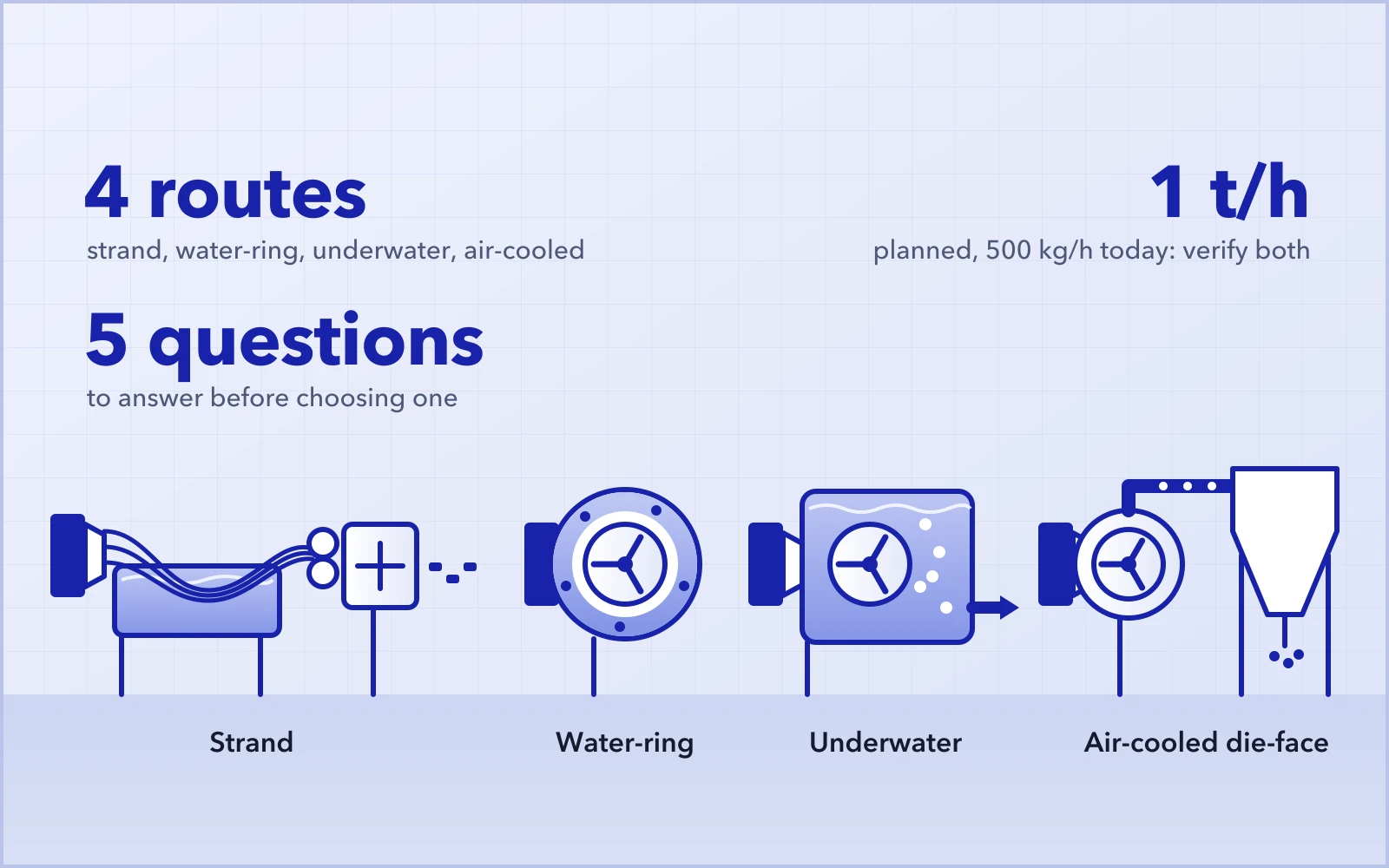
In plastic compounding, some lines cut pellets from cooled strands; others cut them right at the die face. The choice is not about which method is more advanced. It is about which route meets the requirements of the material, the throughput and the finished product.
When a new line is being planned, customers often ask: if we want to stop threading strands by hand, should we simply switch to a water-ring pelletizer? Above what output does underwater pelletizing become a must? If the formulation must not contact process water, is air-cooled die-face pelletizing the only option?
None of these questions can be answered from an output figure or a resin name alone. A pelletizer never works on its own: if the die, cooling, conveying, dewatering or drying does not match, the on-spec output of the whole line suffers.
No single pelletizing method is best for every application. Screen the material limits first, compare the candidate routes against your own production requirements, then confirm the choice with a targeted trial
01What the Four Pelletizing Methods Actually Change
The most obvious difference is where the melt is cut, and how it is cooled before and after the cut.
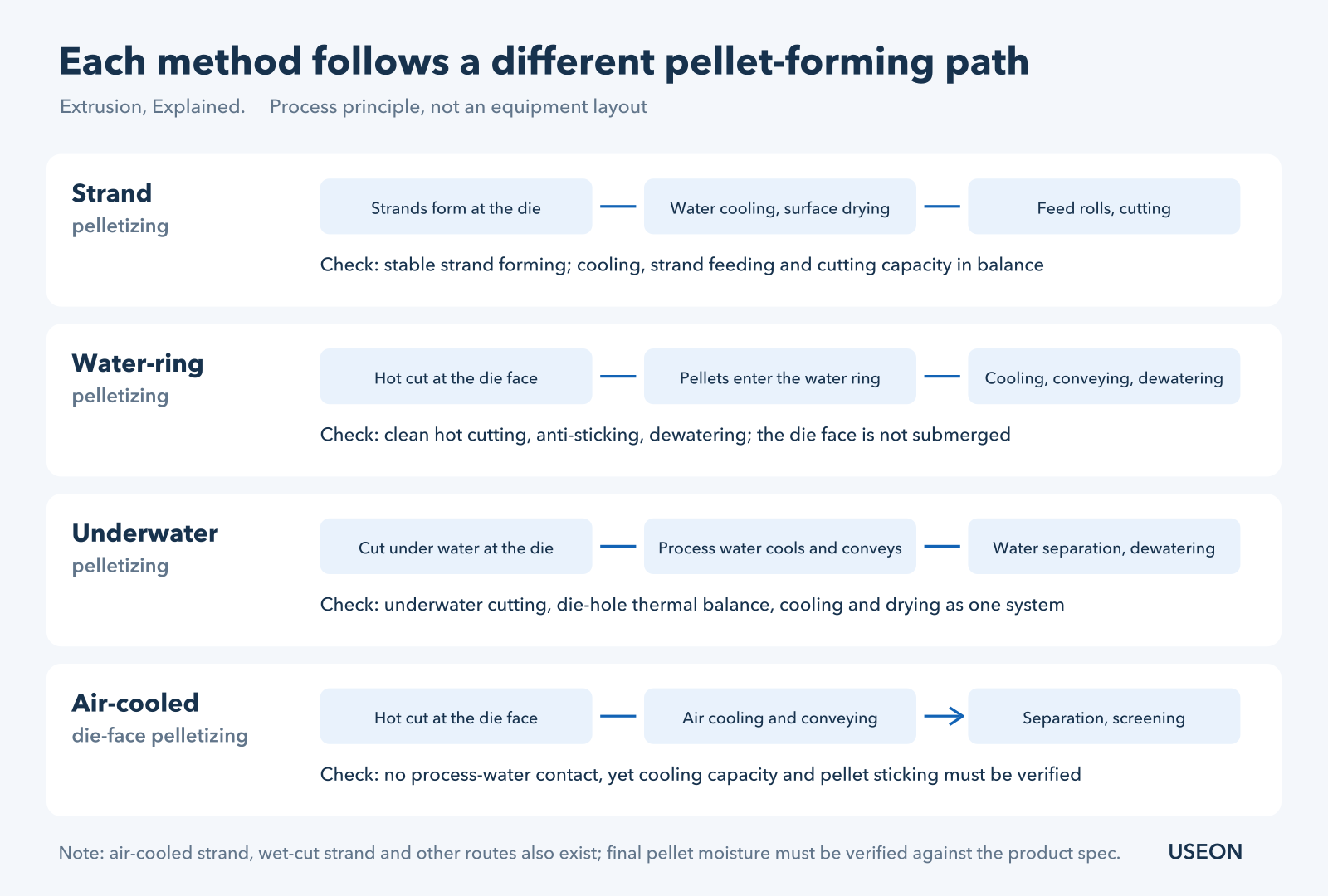
In this guide, "underwater pelletizing" means underwater die-face pelletizing; underwater strand pelletizing and other routes are not covered.
Strand Pelletizing: Form the Strands, Cool Them, Then Cut
The melt leaves the die as continuous strands. They are cooled in a water bath, stripped of surface water and drawn by feed rolls into the pelletizer. The pellets are usually cylindrical. The route suits most compounding work, from color and additive masterbatches to many glass-fiber-reinforced compounds.
This route first needs a material that forms stable strands and reaches the pelletizer in the right condition. Strands that are too soft, stick together or snap all disturb continuous production.
Strand pelletizing does not mean low output, and it does not mean threading by hand. Automatic strand threading and similar options raise the level of automation; actual capacity also depends on the number of die holes, cooling, strand conveying and the pelletizer itself. For materials that strand well, and for processes where operators need to watch the melt leaving the die, a water-cooled strand pelletizing system deserves to be evaluated first.
Water-Ring Pelletizing: Hot Cut at the Die Face, Then into a Water Ring
Water-ring pelletizing does away with the long strand path. Rotating knives cut the melt at the die face and throw the pellets outward into a circulating water ring, where they are cooled and carried on to dewatering. Unlike underwater die-face pelletizing, the die face of a water-ring pelletizer is not submerged.
So the question is not only whether you can stop threading strands. You also need to confirm that the material cuts cleanly while hot, that the pellets do not tail, smear on the knives or clump as they enter the cooling stage, and that pellet quality after dewatering meets the specification.
Typical candidates include PE, EVA, PS and PP-based filler masterbatch, and the pellets are usually flat, lens-like discs. Suitability still cannot be judged from the resin name. On the same base polymer, a different filler loading, viscosity or additive package can change how the melt cuts.
Underwater Pelletizing: Cut Under Water, Carried Away by Process Water
Underwater die-face pelletizing cuts the melt inside a water-filled cutting chamber. The process water both cools the pellets and conveys them on to pellet–water separation and dewatering, followed by drying where needed.
It fits well into a continuous, integrated line design, and it is a candidate for some high-output projects, for suitable thermoplastic elastomer formulations such as TPE, TPU and POE, for hot-melt adhesives, and for products with specific pellet requirements such as micropellets or a narrow size distribution. The pellets are close to spherical or lens-shaped. With soft, tacky formulations, check for clumping through cooling, drying, conveying and storage, not only at the outlet of the cutting chamber. But there is no universal tonnage above which underwater pelletizing becomes mandatory.
Besides output, check the thermal balance across the die holes, how the material cuts, the process water conditions, pellet sticking and the drying requirement. Process water temperature is a key setting in its own right: water that is too cold makes the die holes freeze off more easily, while water that is too warm lets soft pellets stick together. A high-output strand line may be the right answer, and a small underwater pelletizer can also make sense: selection depends on the formulation, the operating range and the pellet specification.
Air-Cooled Die-Face Pelletizing: No Process Water, but Cooling Still Has to Work
Air-cooled die-face pelletizing cuts the melt hot at the die face and uses air to cool and convey the pellets. For formulations that must not contact process water, it is one of the routes to evaluate. Typical applications include PVC compounds, wood-plastic composites (WPC) and some highly filled or halogen-free flame-retardant (HFFR) compounds.
Avoiding water does not make cooling easier. You still need to check whether pellets stick together while being conveyed, whether air cooling can keep up with the target output, and what dust, noise and floor space the system brings.
There is also air-cooled strand pelletizing: strands are formed first, cooled by air, for example on an air-cooled conveyor, and then cut. A material that cannot contact water is not limited to hot die-face cutting with air cooling.
The Four Routes at a Glance
| Route | Shortlist It When | Check First |
|---|---|---|
| Water-cooled strand | The material forms stable strands and may contact water | Strand breaks, cooling and feeding capacity, pellet integrity |
| Water-ring die-face | The melt cuts cleanly while hot and the pellets stay separate in the water ring | Tailing, smearing on the knives, clumping, quality after dewatering |
| Underwater die-face | An enclosed cut with water transport, or a specific pellet shape or size distribution, is needed | Die-hole thermal balance, start-up, minimum output, drying |
| Air-cooled die-face | Process water is not allowed and the formulation suits hot cutting | Cooling capacity, sticking, conveying, dust |
This table builds a shortlist; the final choice is confirmed by trials with your formulation. Where water is not allowed, air-cooled strand pelletizing is a further candidate.
02Answer These Five Questions Before You Choose
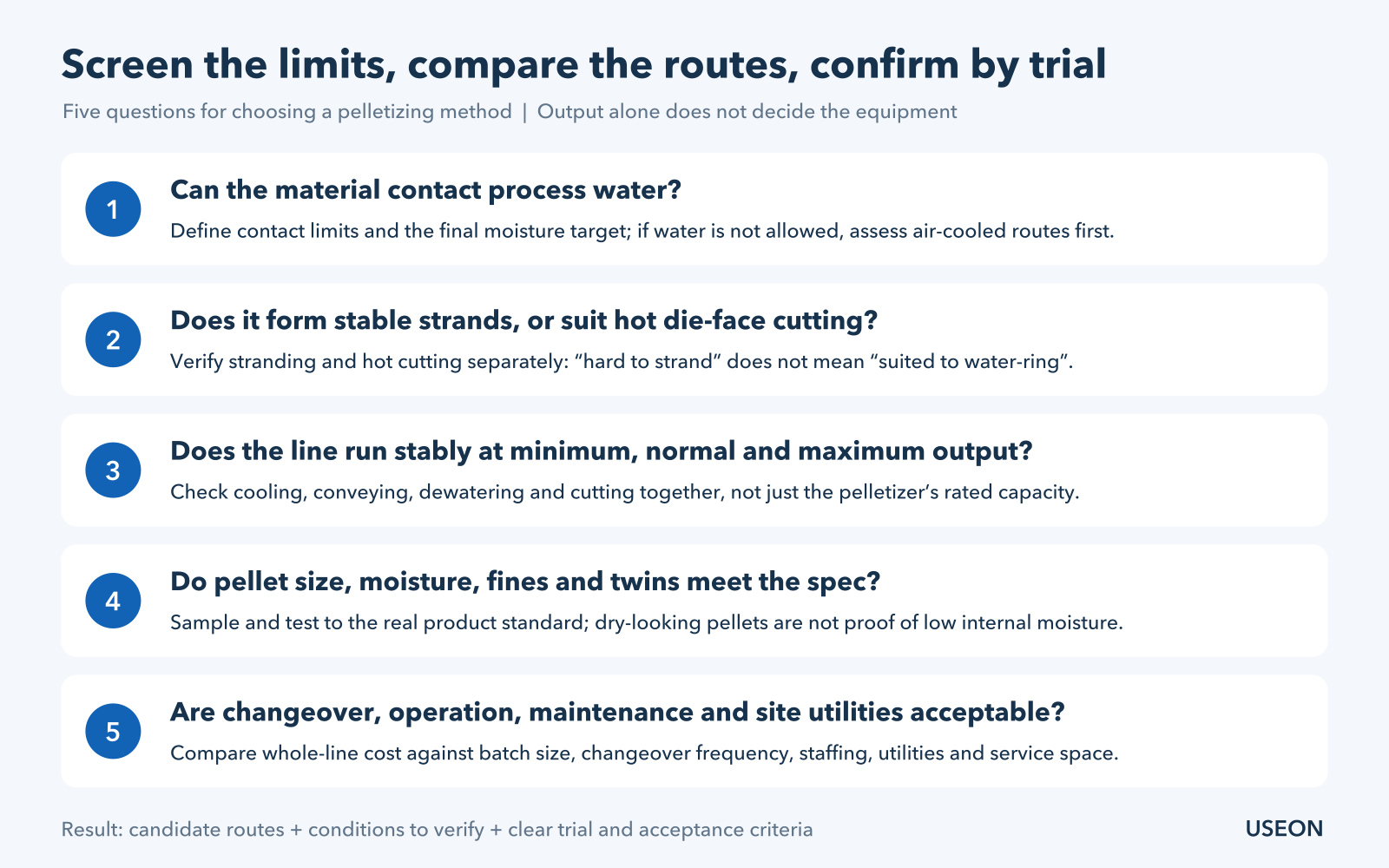
Must the Material Avoid Water, or Is the Final Moisture Spec Strict?
These are two different questions. If the process does not allow any contact with process water, screen for routes without water cooling first. If the material tolerates brief contact with water but the finished pellets have a strict moisture limit, evaluate the contact time, dewatering and downstream drying.
Removing surface water does not mean the moisture inside the pellets is on spec. Pellets that feel dry are no proof; test them against the product requirement.
Does It Form Stable Strands? Can It Be Cut Cleanly While Hot?
For strand pelletizing, check whether the strands run continuously and steadily from the die to the pelletizer. For water-ring or underwater pelletizing, check whether the melt cuts cleanly in that cutting environment and whether the pellets cool in time without sticking.
"The strands are hard to run" does not lead to "water-ring will be easy". If the problem comes from fluctuation in the upstream extrusion or uneven flow across the die holes, changing the pelletizing method may not remove the root cause.
Peak Output, or the Whole Operating Range?
Give the supplier the minimum, normal and maximum output, not just a peak figure. If today's orders need 500 kg/h and the plan is 1 t/h, both duties should be verified.
As output rises, a strand system must be checked for cooling, strand conveying and cutting capacity; water-ring and underwater systems for cutting, process water, dewatering and post-treatment. An extruder that can push the material out does not mean the whole line delivers on-spec pellets steadily.
The minimum output matters as much. In underwater pelletizing, every active die hole needs enough melt flow and heat to stay open against the process water, so at low throughput the holes freeze off more easily. Start-up has to be coordinated as well: process water that reaches the die face too early can freeze the holes, and water that arrives too late lets the first pellets clump. Verifying the minimum output is therefore more than checking that the line can run slower.
What Pellet Specifications Must Be Met?
Define size and size distribution, shape, moisture content, fines, twins and stuck-together pellets. Strand pellets are usually cylindrical, water-ring pellets flatter and lens-like, and underwater pellets close to spherical or lens-shaped, but rounder pellets are not necessarily better.
For glass-fiber-reinforced, brittle or abrasive formulations, also consider how cutting and drying affect pellet integrity and the life of wear parts. Judge by the finished-product requirement, not by a single sample photo.
Will Changeovers and Maintenance Eat Up the Production Gains?
A plant that changes colors and formulations often has different priorities from one that runs a single product continuously. Beyond rated capacity, compare start-up and shutdown, cleaning, transition material, knife maintenance, staffing and the site's water and power supply.
Ask in particular: how long does it take from the last on-spec pellet of one product to the first on-spec pellet of the next? Which parts have to be cleaned? Which spare parts are needed? Do not let "strand is simple" or "underwater is highly automated" stand in for a concrete comparison.
Rule a configuration out only when it cannot meet the requirement under conditions that have actually been verified. A strand that breaks during one run may point to fluctuation upstream, and water-ring, underwater and air-cooled die-face pelletizing each cool the pellets differently, so a result from one does not settle the others.
03Turn Customer Requirements into Verifiable Selection Criteria
| Customer Requirement | What to Verify | Conclusion Not to Jump To |
|---|---|---|
| Less manual strand threading | Automatic strand threading, or whether die-face pelletizing suits the material; labor needed for start-up, shutdown and changeover | Avoiding strand threading means switching to water-ring |
| Higher continuous output | Cooling, cutting, dewatering and operating stability of each candidate route at the target load | High output requires underwater pelletizing |
| No contact with process water | Cooling, anti-sticking and pellet quality of the air-cooled strand or air-cooled die-face route | Air cooling is just a different pelletizer |
| Frequent color and material changes | Full changeover time, transition material, residues and cleaning scope | One method is always the fastest to change over |
| Strict pellet moisture spec | Final moisture after dewatering and drying, measured by the specified test method | No surface water means the spec is met |
04In a Trial, "It Makes Pellets" Is Not Enough
Before the trial, agree on the actual formulation, the raw material condition, the target output range, the continuous run time and the acceptance criteria. When comparing routes, keep these conditions the same as far as possible and record whatever could not be kept the same.
During the trial, watch four things:
- Continuityfrequent strand breaks, sticking pellets, stops for cleaning or reliance on manual intervention;
- On-spec outputrecord the on-spec output, not the momentary extrusion rate, and test size, moisture and the agreed properties;
- Changeoverwhere several products are made, run a real color or material change;
- The whole linerecord cooling, dewatering, energy use and operating demands, with a clearly defined boundary for the energy measurement.
A short trial can prove that pellets can be formed and show part of the running behavior, but it cannot prove long-term knife life, maintenance cost or year-round continuous operation. Those need operating records, application experience and follow-up verification.
FAQs
Do I need a water-ring pelletizer to stop threading strands by hand?
Not necessarily. Automatic strand threading raises the automation of a strand line, and die-face pelletizing only helps if the material cuts cleanly while hot without tailing, smearing or clumping. Compare the labor for start-up, shutdown and changeover on both routes.
Above what output is underwater pelletizing required?
There is no universal threshold. A high-output strand line can be the right choice, and a small underwater system can make sense too. Check die-hole thermal balance, start-up, cutting behavior, process water, pellet sticking and drying for your formulation across the whole operating range, minimum output included.
My material must not contact water. Is air-cooled die-face pelletizing the only option?
No. Air-cooled strand pelletizing is another route. For either, check the cooling capacity at the target output, pellet sticking during conveying, dust, noise and floor space.
Are round underwater pellets better than cylindrical strand pellets?
Not necessarily. Judge the pellets against the product specification: size distribution, moisture, fines, twins and pellet integrity, not shape alone.
Conclusion
Define the On-Spec Pellet First, Then Choose the Pellet-Forming Path
Choosing a pelletizing method is not ranking four machines. It is comparing routes for a specific formulation and specific production requirements.
Confirm the material limits first, then the output range and the pellet specification, and finally compare continuous operation, changeover and maintenance cost. Once these conditions are clear, the choice has a sound basis.
This guide supports preliminary selection; it does not replace trials with your formulation or project engineering. The diagrams are schematic and do not show actual equipment design or installation dimensions.
If you are planning a twin-screw pelletizing line, send USEON the material and formulation range, target output, pellet requirements, any limits on water contact, changeover frequency and site conditions. A discussion built on this information finds the right configuration faster than asking which pelletizer is best. See all USEON pelletizing systems.