
SAT75 Twin Screw Devolatilization Pelletizing Line for Bio-based Semi-aromatic Polyamide
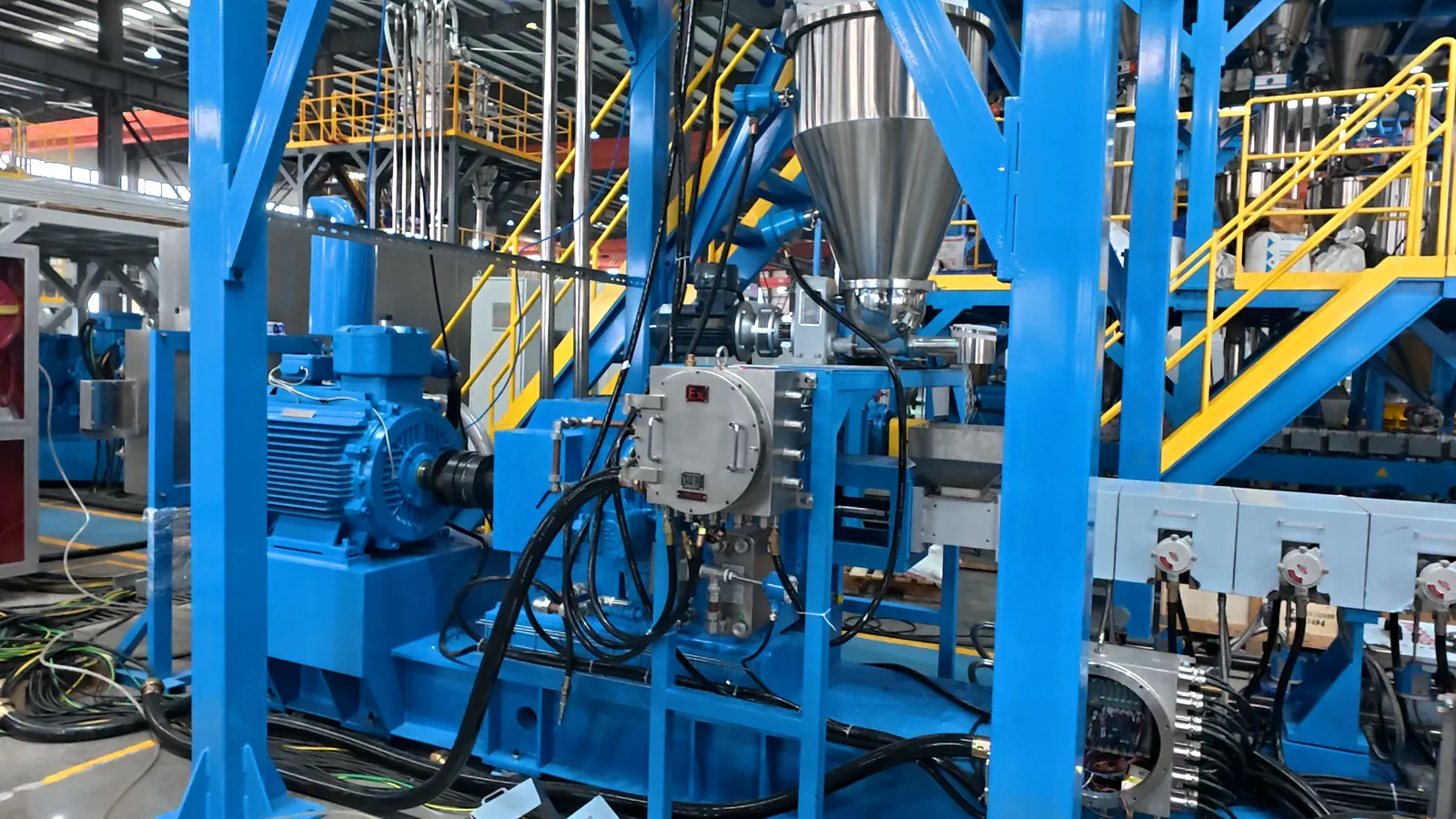
USEON built this SAT75 (L/D 64) twin screw devolatilization pelletizing line to pelletize a customer’s bio-based semi-aromatic polyamide powder at 150–200 kg/h. The whole line, from powder loading to weighing and bagging, is designed for both gas and dust explosion protection.
Background & Requirements
Polyamide melt is sensitive to moisture: at processing temperature, residual water hydrolyzes the polymer, lowers its viscosity and leaves bubbles in the pellets. On this line the material is fed as powder, and the plant requires protection against both gas and dust explosions. The design focused on four points:
Heavy water removal
2–3% water has to be removed during extrusion, and the pellets leave the line with less than 0.6% moisture.
Powder feeding
The powder has a bulk density of about 0.7 g/cm³ and must be fed continuously and steadily, without bridging or interruptions.
Gas and dust explosion protection
Electrical equipment is designed to Ex d IIC T4 Gb and Ex tb IIIB T200°C Db, covering both gas and dust atmospheres.
Remote control
The line is operated from its own PLC on site and can also be operated and monitored from the plant DCS.
Process Flow
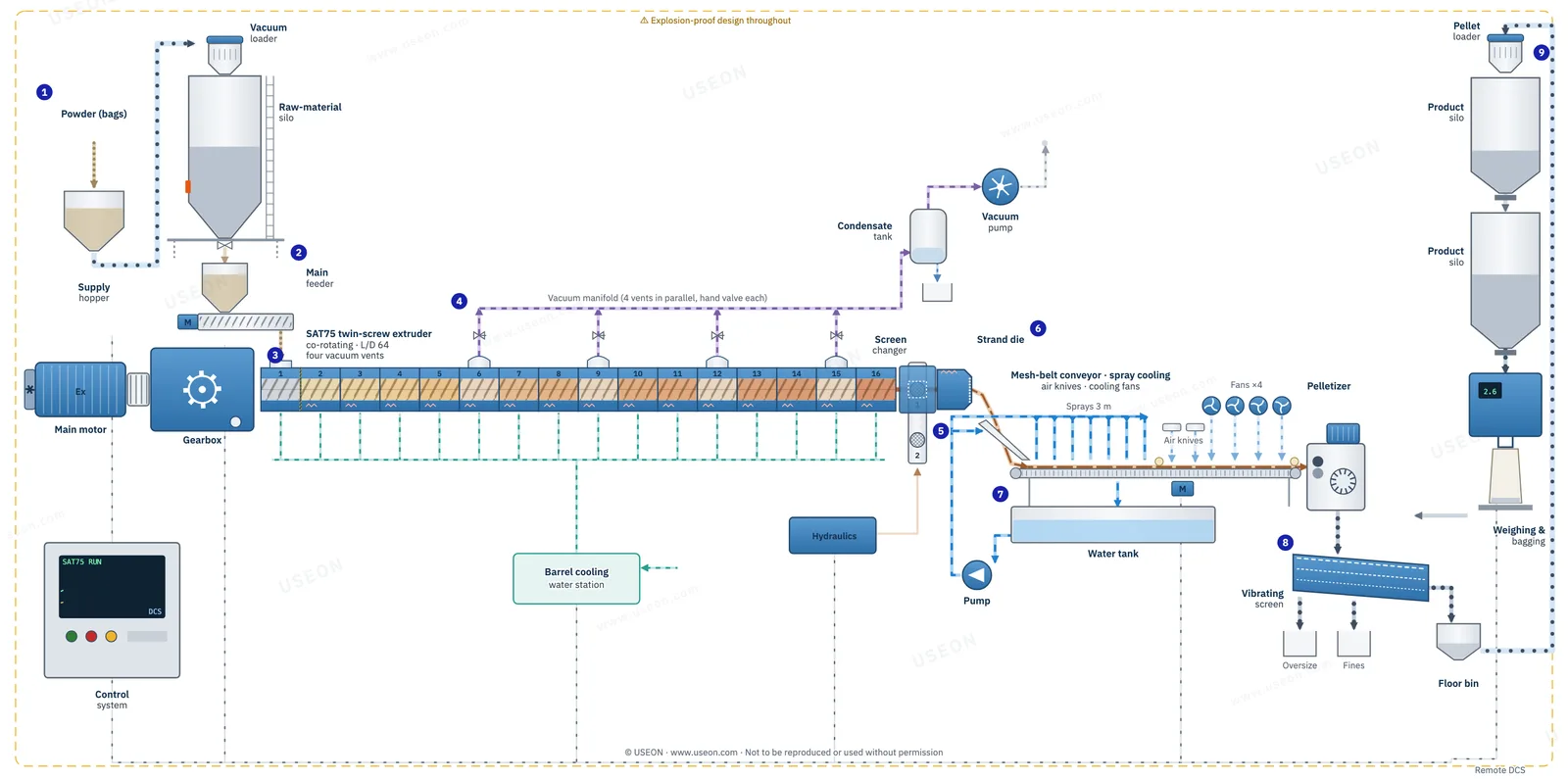
The line runs in nine steps, from powder loading to weighing and bagging. The design choices behind the main stations are under Key Configuration & Design.
 Open interactive diagram
Powder loading
Bagged powder is emptied into a supply hopper and lifted by a vacuum loader into a 3 m³ material silo.
- Supply hopper
- Powder vacuum loader
- Material silo
Twin screw feeding
A twin screw feeder meters the powder continuously into the first barrel and refills from the silo automatically.
- Twin screw feeder
SAT75 twin screw extrusion
A 75 kW explosion-proof motor drives the co-rotating SAT75 (L/D 64) through a safety coupling and gearbox, for a screw speed of 30–300 rpm. Each barrel zone is heated separately and cooled by a closed soft-water loop.
- Main motor
- Safety coupling
- Gearbox
- SAT75 twin screw extruder
- Barrel cooling water station
Four-stage vacuum devolatilization
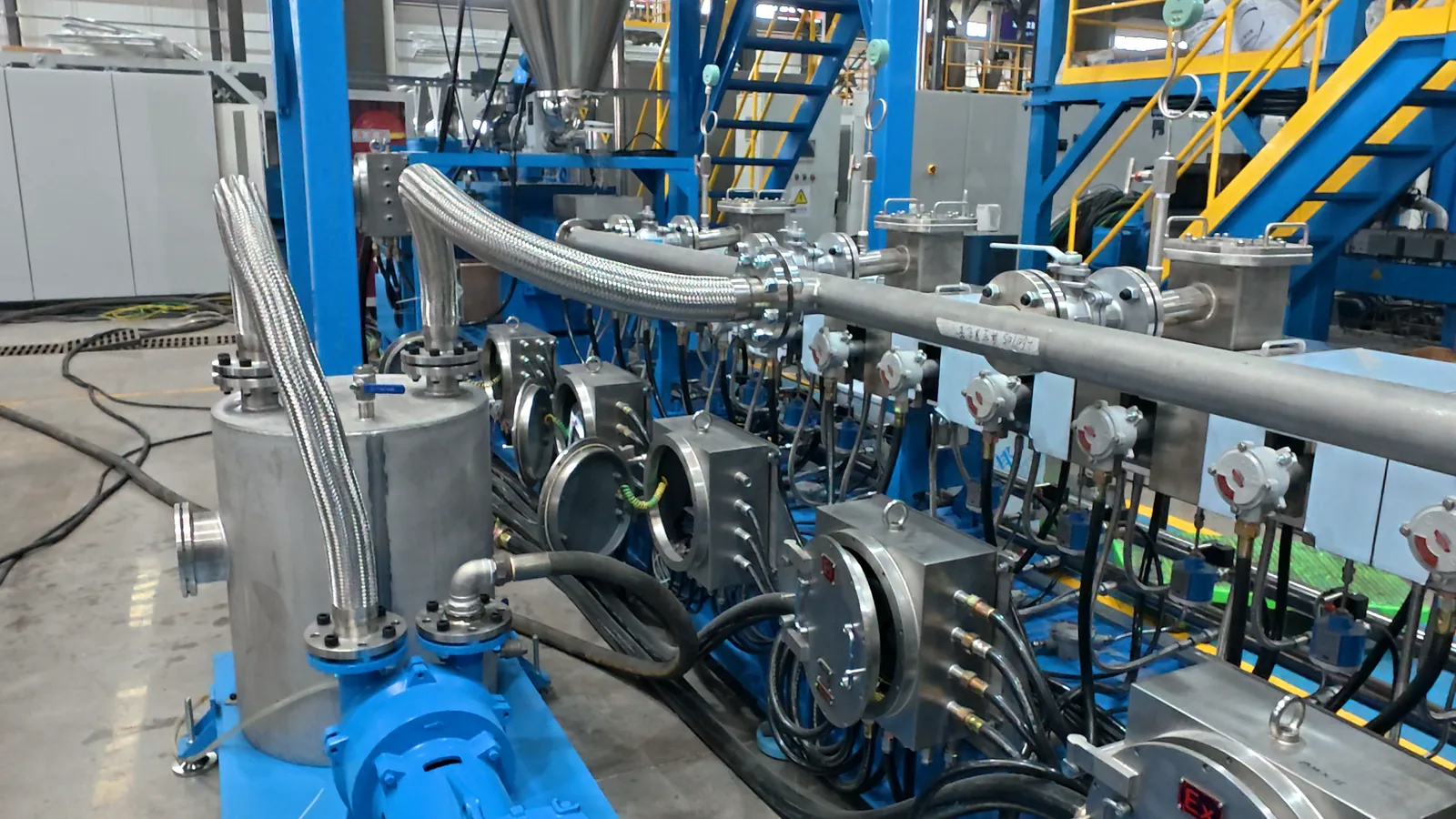
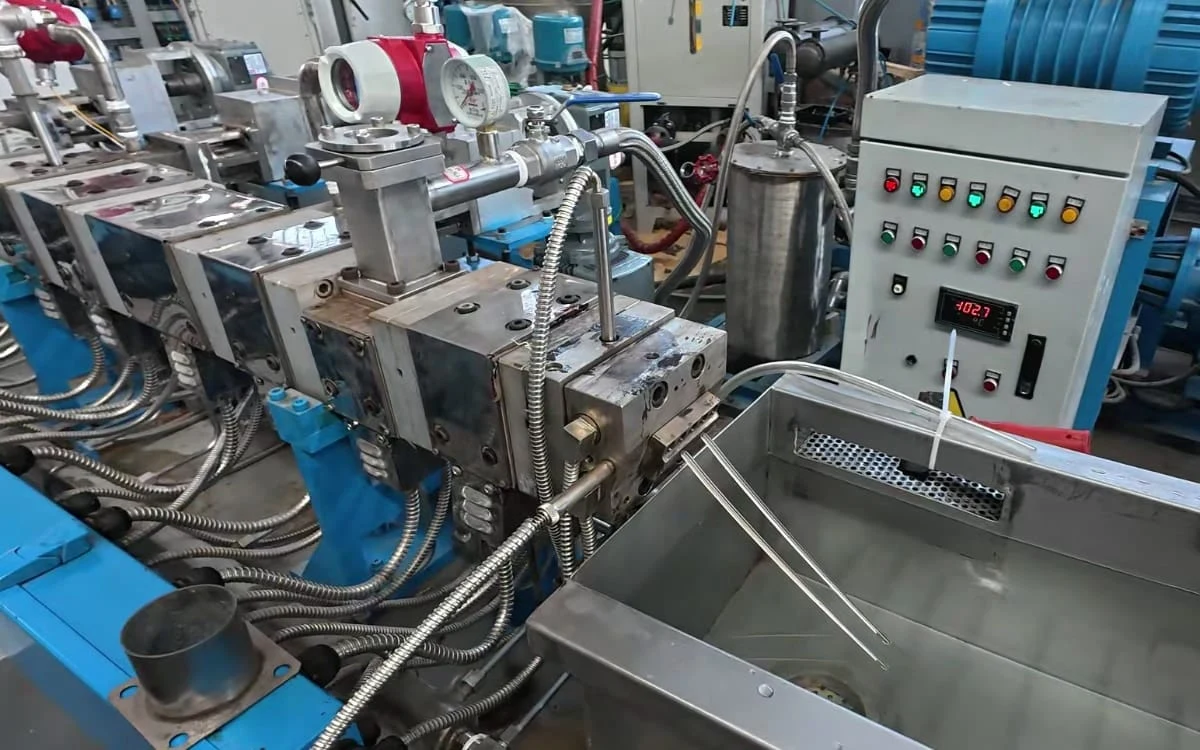
Four vents, connected in parallel to one vacuum manifold, draw off water and volatiles and remove the 2–3% water in the feed. A condensate tank collects the condensed vapor before the 7.5 kW water ring vacuum pump.
- Vacuum vents
- Condensate tank
- Water ring vacuum pump
Hydraulic screen changing
A two-position hydraulic plate screen changer filters the melt, and the screens are changed without stopping the line.
- Plate screen changer
- Hydraulic unit
9-hole strand die
The 9-hole die forms continuous strands that drop into a water flushing trough.
- Strand die
Spray belt cooling
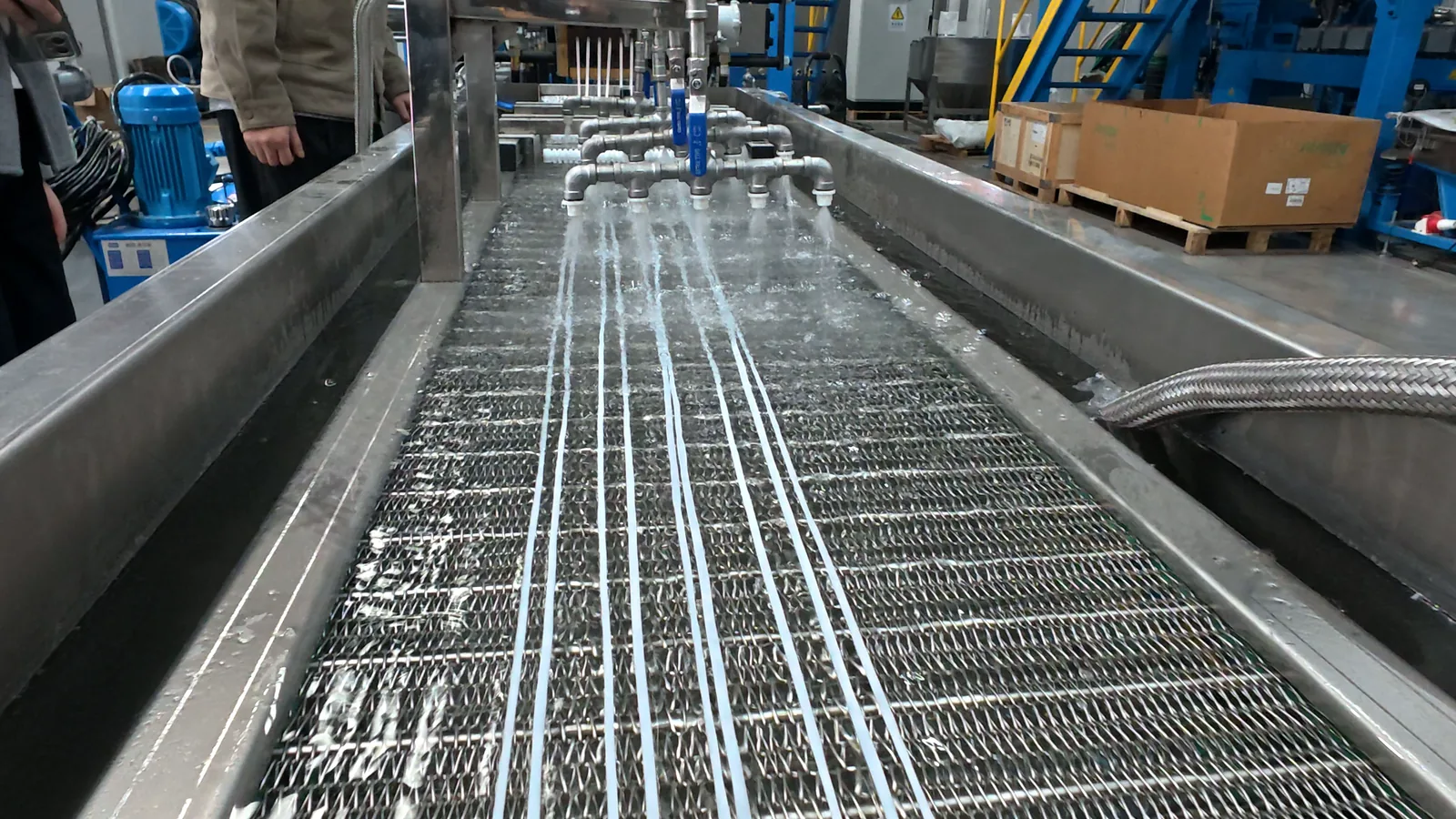
A 6 m stainless steel mesh belt, adjustable from 10 to 75 m/min, carries the strands under a 3 m spray section. Two sets of air knives and four axial fans then dry their surface.
- Mesh belt conveyor
- Water tank
- Spray water pump
Strand pelletizing
The strand pelletizer, rated at 300 kg/h, cuts pellets of about Φ3 × 3 mm, and a three-deck vibrating screen removes joined pellets and fines.
- Strand pelletizer
- Vibrating screen
- Floor bin
Weighing and bagging
A vacuum loader fills two stacked 3 m³ product silos, which discharge to a semi-automatic packing machine that weighs and bags 25 kg or 50 kg; the bags are placed by hand.
- Pellet vacuum loader
- Upper product silo
- Lower product silo
- Semi-automatic packing machine
Control and explosion protection: One Siemens S7-1200 PLC runs the whole line and links to the plant DCS, and the electrical equipment is designed for both gas and dust explosion protection.
Key Configuration & Design
L/D 64 for long residence time
The L/D 64 barrel, run at a relatively low screw speed, keeps the melt in the barrel longer and constantly renews its surface, so the water vapor has enough time to escape.
Individually adjustable vacuum vents
Each of the four vents has its own manual valve, so the vacuum at each vent can be set separately: for example, the front vents take off most of the vapor while the rear vents run at a higher vacuum.
Anti-bridging powder feed with interlocks
A pneumatic wall vibrator prevents bridging in the material silo, and high and low level alarms warn before it overfills or runs empty. The feeder is interlocked with the extruder: if the feeder fails, the extruder stops after a delay; if the extruder stops, the feeder stops at once.
Variable-speed drive with safety coupling
Schneider variable-frequency control sets the screw speed, and a safety coupling disengages automatically on torque overload.
PLC monitoring and interlocks
The touch screen shows temperature, pressure, vacuum, material levels, motor current and equipment status in real time, and the PLC handles all process interlocks and the start and stop sequences.
Project Video
Factory Trial Run
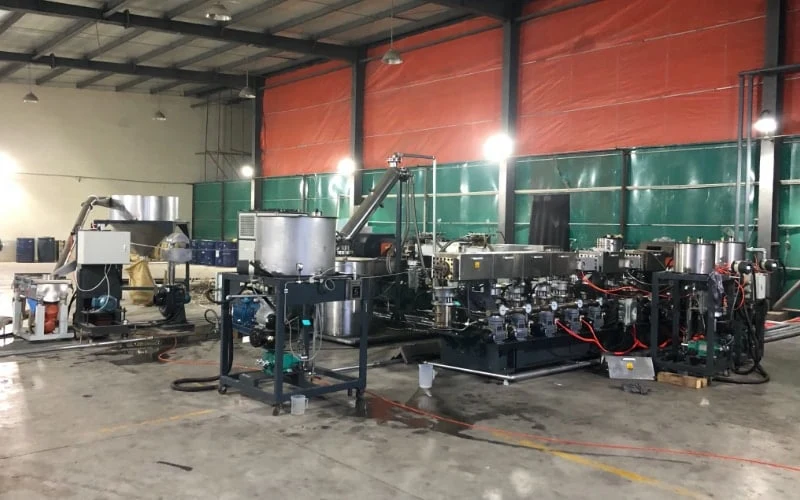
Before shipment, the line was trial-run at the USEON factory, running continuously from feeding to bagging. All four vacuum vents worked normally, and the 9-hole die delivered continuous strands, which were cooled on the spray belt, dried by the air knives and cut in the pelletizer. The pellets then went through the product silos to the packing machine to be weighed and bagged.
Other Applications
Multi-stage vacuum devolatilization combined with spray belt strand pelletizing also suits:
- Other moisture-sensitive engineering plastics with a pellet moisture limit, such as polyamides and polyesters
- Reactive extrusion that has to remove by-products or residual monomer during extrusion
- Compounds that release gases or volatiles during mixing, where pellet voids and odor matter
- Materials with low melt strength or brittle strands that are not suited to a long water bath
The number of vents, the L/D and the cooling method are chosen for the material and the output. More devolatilization options are described under Devolatilization, and strand pelletizing configurations under Water Cooling Strand Pelletizing System.
Related projects: the explosion-proof SAT65 twin screw extruder for PLA/PETG/ABS compounding, the SAT95 twin screw line for PA waste fiber recycling, and the 24-hour continuous trial run of a petrochemical devolatilization project.
FAQ
Why does semi-aromatic polyamide pelletizing need vacuum devolatilization?
A: Polyamide melt is sensitive to moisture. At processing temperature, water in the melt hydrolyzes the polymer, lowering its molecular weight and viscosity and leaving bubbles in the pellets. The more water there is to remove, the more vent stages are needed: each vent takes away only part of the vapor, so several vents along the barrel, with enough residence time, are needed to bring the pellet moisture below the limit.
What matters when feeding powder?
A: Powder tends to bridge and interrupt the feed. Any fluctuation in feeding changes how full the screws are at the vents, so devolatilization varies and the strands become uneven or even break. A powder line therefore needs continuous, steady conveying, storage and dosing, with the feeder interlocked with the extruder so the screws neither run empty nor get overfed.
Why a spray belt instead of a conventional long water bath?
A: In a long water bath the strands are pulled through the water, so brittle strands or melts with low strength break easily, and threading the strands at start-up takes effort. On a spray belt the mesh belt carries the strands while water sprays from above, so the strands are under little tension and are easy to thread.
What is the main configuration of this line?
A: A SAT75 co-rotating twin screw extruder with L/D 64 and a 75 kW explosion-proof main motor; four-stage vacuum devolatilization; a hydraulic plate screen changer; a 9-hole strand die with spray belt cooling, air knives and a strand pelletizer; a vibrating screen, product silos and weighing and bagging; Siemens PLC control that can be connected to the plant DCS. The whole line is designed to Ex d IIC T4 Gb and Ex tb IIIB T200°C Db for gas and dust, with an output of 150–200 kg/h.
Does your material need devolatilization, or do your pellets have a moisture limit? Contact the USEON team with your material, target output and pellet specification, and we will configure a suitable line.
Tell us your material, formulation and target throughput.
- 01Process review
- 02Engineer call
- 03Line proposal

Souder Chen
Head of Compounding Division
With USEON since 2008. Twin screw compounding, devolatilization and recycling lines.