
Two-Stage Lab Extrusion Line for Polymer Devolatilization
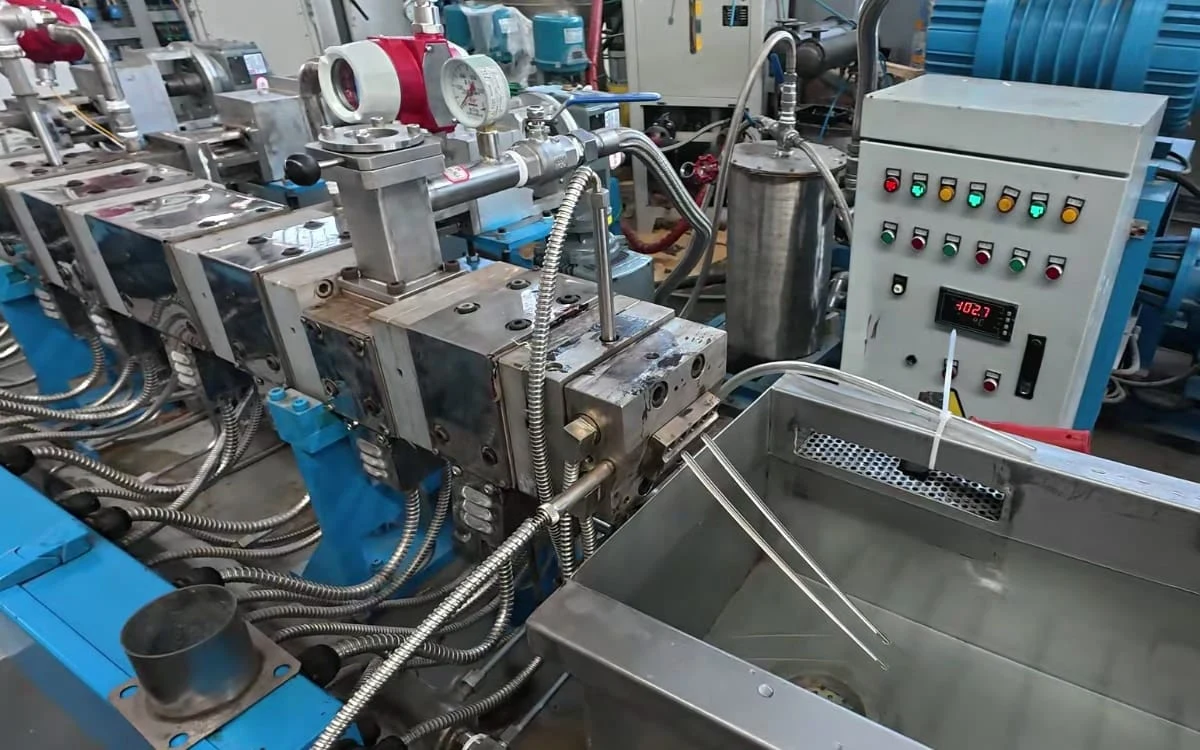
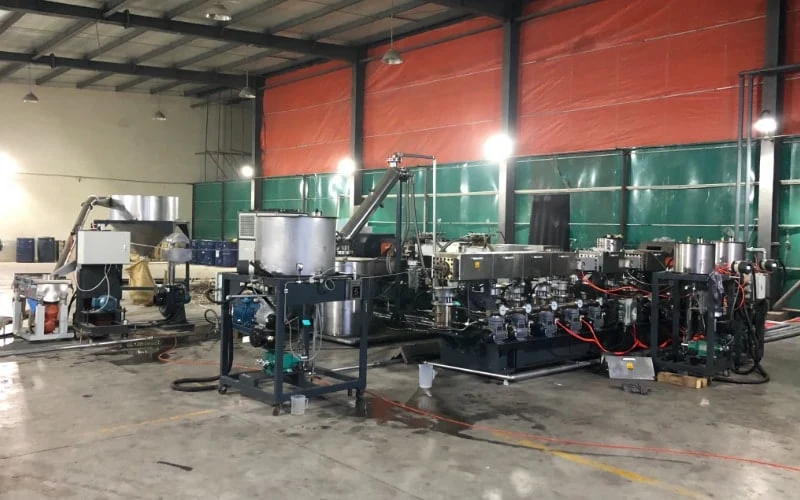
An H-type two-stage lab line for a chemical producer in East China. A LAB35 extruder (L/D 74) washes the specialty polymer with high-pressure liquid injection, and a LAB30 extruder (L/D 58) completes devolatilization.
Background and Challenges
This project was delivered to a leading chemical industry powerhouse in East China. The client faced significant processing hurdles in developing a high-performance specialty polymer requiring rigorous post-synthesis purification.
Process Bottlenecks
The nascent polymer contained high levels of residual solvents and impurities, necessitating a continuous multi-stage “washing-extraction-devolatilization” process to achieve optical or medical-grade purity.
Corrosion Issues
The acidic washing agents and reaction byproducts posed a severe corrosion threat to standard equipment, demanding metallurgy far superior to conventional nitrided steels.
R&D Flexibility
As a pilot line, the system required an extremely wide operating window to simulate the complete phase transition from low-viscosity solutions to high-viscosity melts.
In-depth Analysis of Material Characteristics
Analyzing the ultra-high L/D configuration (Stage 1: L/D 74, Stage 2: L/D 58), the material processing involves distinct complexities:
Multiphase Flow & Separation
The process involves complex “solid-liquid-liquid” interactions within the barrel. Precise shear control is critical to achieve efficient mass transfer (washing) followed by phase separation (liquid drainage).
Extended Residence Time
The combined L/D ratio exceeding 130D indicates that the reaction or purification kinetics require substantial residence time to ensure complete conversion and solvent removal.
Metallurgical Sensitivity
The polymer system is sensitive to metal ion contamination and operates in a highly corrosive environment, mandating the use of specific chemically inert alloys.
USEON Solution
H-Type Dual-Stage Architecture:
- Stage 1 (LAB35 Twin Screw Extruder, L/D 74): Functions as the primary reaction and washing zone. Its extended length accommodates three high-pressure liquid injection systems (up to 15Mpa) and extensive mixing zones for micro-level solvent dispersion.
- Stage 2 (LAB30 Twin Screw Extruder, L/D 58): Dedicated to deep devolatilization and pressure build-up, ensuring minimal volatile content in the final pellets.
- The H-arrangement optimizes the melt flow channel between stages while reducing the vertical clearance required for installation.
Dynamic Liquid Drainage & Injection:
- The line features three sets of Dynamic Liquid Drainage units. These counter-rotating twin-screw side units force extracted liquids out of the barrel while preventing polymer melt leakage—a significant upgrade over passive drainage methods which often clog.
- Specialized liquid injection barrels allow precise introduction of washing agents even into high-pressure melt zones.
Premium Corrosion Resistance:
- The Stage 1 barrels are constructed from 630 Stainless Steel with Nickel-Based Alloy liners (HRC50), and screw elements are machined from 630 SS. This metallurgy effectively neutralizes intergranular corrosion risks in acidic environments.
- Stage 2 and downstream components utilize 304 Stainless Steel and Nickel alloys to maintain a contamination-free process.
To address these challenges, USEON engineered a bespoke H-type two-stage washing and devolatilization system:
Project Video
Get a quote
Tell us your material, formulation and target throughput.
- 01Process review
- 02Engineer call
- 03Line proposal

Souder Chen
Head of Compounding Division
With USEON since 2008. Twin screw compounding, devolatilization and recycling lines.