
Engineering Plastic Reinforcing Compounding Line in German
- Clients in: Compounding
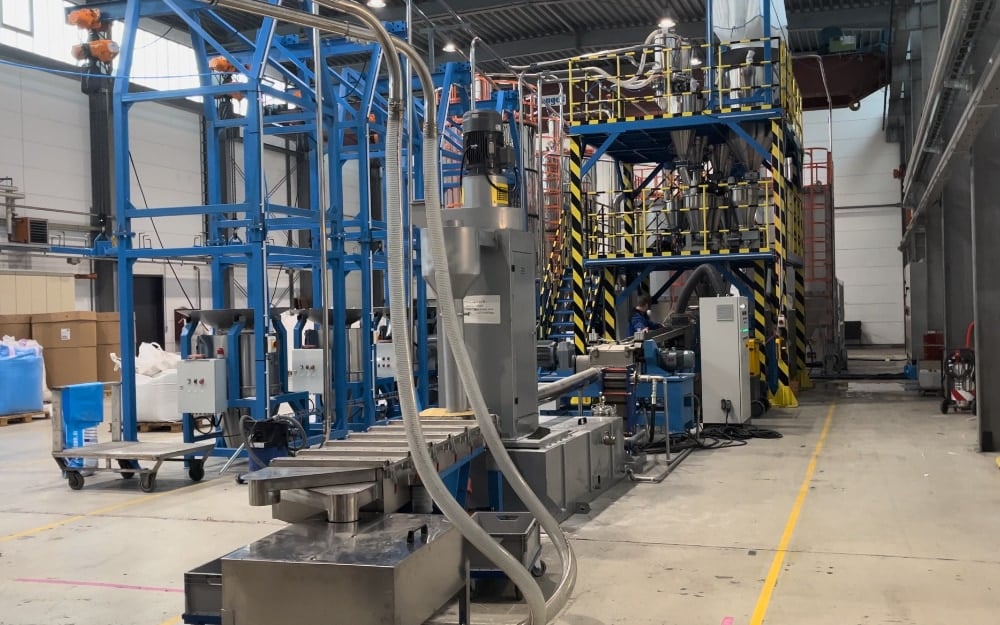
Customized for a German client, this USEON U6 twin screw compounding line is designed for high-glass-fiber and powder-filled engineering plastics (PBT/PA/PP), achieving stable pelletizing output of around 800 kg/h during on-site commissioning.
Project Overview
- Customer Location: Germany
- Machine Model: U6 twin screw extruder equipped with an under water strand pelletizer system
- Typical Formulation: Base resins (PBT, PA, or PP, 12% to 90%), inorganic powders (10% to 50%), glass fibers (10% to 50%), and associated additives (1% to 5%).
- Designed Capacity: ~800 kg/h
- Core Drive Configuration: Siemens 280kW AC motor, Zambello ZT52/65COR-HT high-speed gearbox (900 rpm)
Background and Challenges
The client is a specialized plastics compounding manufacturer in Germany. When processing polymer systems with high proportions of glass fiber and inorganic powders, the project encountered the following primary engineering challenges during the evaluation phase:
Equipment Wear from High Loading
Formulations contain high percentages (up to 50%) of glass fibers and inorganic powders. During continuous extrusion, these materials cause notable abrasive wear to the barrel and screw elements, directly impacting the equipment’s maintenance cycle and process stability.
Continuous and Stable Multi-Component Feeding
The complex formulation system, encompassing resins, powders, additives, and glass fibers, requires the feeding system to maintain precise ratio coordination during continuous production runs.
Line Integration and Data Connectivity
Located in Europe, the line must comply with local CE safety standards. The extruder’s automated control system must be capable of establishing a data link with the client’s existing SAP management system.
Why This Configuration
Tailored to the client’s material characteristics and production requirements, the U6-48 twin extruder and its supporting systems are configured based on the following engineering necessities:
- Abrasion Challenge and Wear-Resistant Selection: Addressing the severe abrasive wear caused by up to 50% glass fiber and powder content is a primary consideration. The working section features industrial-grade wear-resistant alloy barrel liners and screw elements, intended to mitigate material degradation and support prolonged continuous operation.
- Multi-Component Accuracy and Loss-in-Weight Feeding: The continuous dosing of resins, powders, and additives demands rigorous ratio control. The integrated multi-component loss-in-weight feeding system is a core configuration for such complex formulations, maintaining dynamic feeding synergy and stability during continuous operation.
- Fiber Retention and Side Feeding Process: To prevent glass fibers from undergoing excessive plasticizing shear, a single-stage side feeder is positioned in the downstream section. This process node allows fibers to merge after the resin matrix has fully melted, serving as the engineering basis for balancing uniform dispersion with the retention of physical fiber length.
- High-Hardness Strands and the Under Water Strand Pelletizer: Given the high post-extrusion hardness of glass-fiber reinforced plastics, conventional cooling often leads to cutting issues or debris. The engineering necessity of the under water strand pelletizer system lies in its extended fluid cooling path, which provides gradual conditioning for the strands before they reach the cutter, stabilizing cut smoothness and limiting dust generation.
Solution
USEON configured a comprehensive pelletizing system covering raw material handling to finished product packaging. The core modules include:
- Wear-Resistant Extrusion Platform: The core unit is the U6-48 twin screw extruder. For high-wear conditions, the working section utilizes wear-resistant alloy barrel liners and screw elements tailored to the friction characteristics of glass fibers and powders.
- Upstream Material Handling System: Equipped with vacuum loaders, desiccant dryers, and a multi-component continuous loss-in-weight feeding system. Combined with the single-stage side feeder, this enables staged, continuous dosing of base resins, powders, and fibers.
- Downstream Pelletizing and Homogenization System: The downstream section features a complete under water strand pelletizer line (including a cold strand diehead, an extended water trough, a pelletizer, and a centrifugal dryer), connected to a finished product homogenization silo and packaging scale.
- Automation Control Hub: The electrical control is built upon a Siemens PLC and HMI. Control cabinets and components comply with CE certification requirements, and standard industrial communication interfaces are provisioned to deploy underlying communication logic with the client’s SAP system.
Project Video
Suitable Applications
This U6 series twin screw compounding configuration is particularly suitable for high-proportion glass fiber reinforcement and high-loading mineral powder compounding projects involving engineering plastics such as PA, PBT, and PP.
For technical evaluations and system configurations regarding engineering plastics compounding projects, we invite you to contact the USEON engineering team.
FAQ
A: For highly abrasive material systems, we configure barrel liners and screw elements made from specialized wear-resistant alloys. Compared to standard steel, their enhanced hardness and wear resistance help extend the maintenance cycle of the equipment under severe operating conditions.
Q2: How does the line balance the dispersion of glass fibers in the polymer while retaining fiber length?
A: Glass fiber reinforced engineering plastics typically have high hardness and heat capacity. The under water strand pelletizer system, utilizing a long water trough and fluid cooling, ensures the strands are sufficiently and uniformly cooled before entering the pelletizer. This helps improve the smoothness of the cut and controls dust.
A: Built on a Siemens PLC architecture, the line not only performs internal logic control but also supports data integration with plant MES or SAP systems via standard industrial protocols, enabling the real-time transmission of production parameters.