
BOPET Crushed Film Recycling Line in Middle East
- Clients in: PET Extrusion
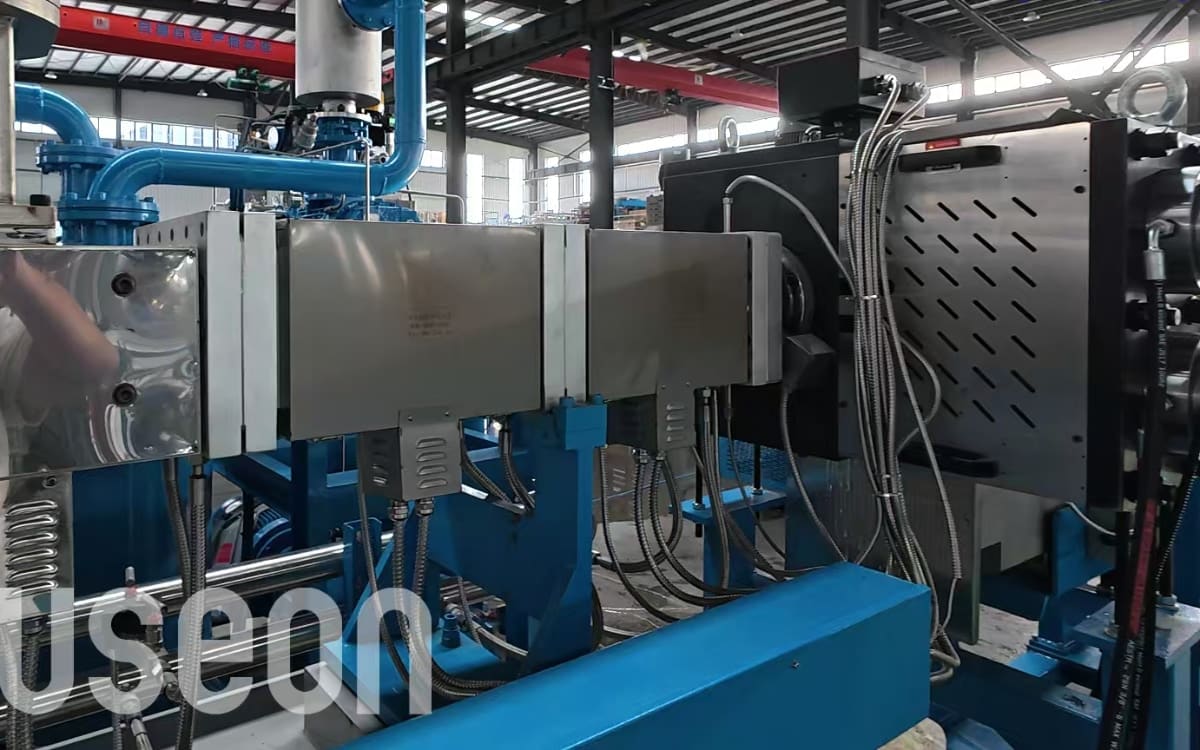
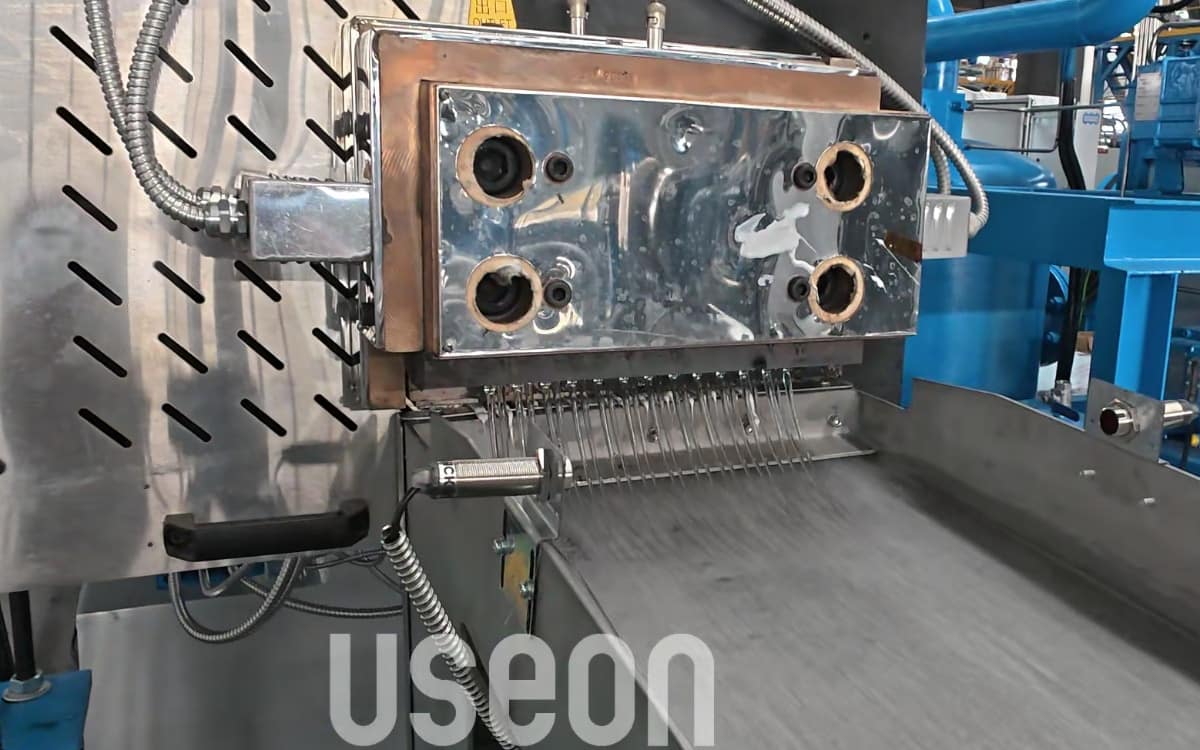
USEON provides this BOPET crushed film recycling solution based on the TDY110-28 twin-screw extruder, combined with a vertical force feeder and a two-stage vacuum degassing system, specifically designed to solve the problems of unstable feeding and hydrolysis tendency in low-bulk-density film materials. Verified by FAT, the line can achieve continuous and stable operation at 600–900 kg/h.
Project Highlights
- Processed Material: BOPET crushed films (bulk density approx. 150Kg/m3)
- Core Equipment: TDY110 (L/D=28) twin-screw extruder
- Drive System: 250Kw Siemens Innomotics main motor with German-made R+W torque limiting coupling
- Output Capacity: 600~900Kg/Hr
- Key Technologies: Vertical force feeder, two-stage vacuum devolatilization system, double-station dual-pillar screen changer
Background and Challenges
In the BOPET film recycling process, handling lightweight materials with a low bulk density of approximately 150Kg/m3 is a primary challenge.
BOPET crushed films are highly prone to bridging at the extruder feed throat, leading to starved feeding and directly restricting the continuous throughput. Furthermore, polyester (PET/BOPET) materials are highly susceptible to hydrolysis during high-temperature melt extrusion.
If volatiles and residual moisture are not efficiently extracted from the melt, the finished pellets are prone to void defects and face the risk of a drop in intrinsic viscosity (IV), thereby impairing their downstream reuse value.
Solutions and Core Technologies
To overcome the feeding bottlenecks of low-bulk-density materials, this solution features a flat-bottom silo and a vertical force feeder at the first open feeding barrel. An auxiliary agitation device, combined with the forced feeding screw, applies continuous mechanical thrust to the BOPET crushed films. This design significantly reduces the probability of material bridging and increases the filling degree in the screw channels, thereby sustaining a stable output of 600~900Kg/Hr.
To address BOPET’s susceptibility to hydrolysis, a dedicated vacuum exhaust chamber is equipped at the 5th barrel, integrated with a two-stage vacuum devolatilization system comprising a Roots pump and a screw pump. This system provides deep dehumidification and devolatilization capabilities during the melting phase, rapidly extracting residual moisture and low-molecular-weight volatiles from the polymer melt. This deep vacuum setup helps suppress high-temperature hydrolysis reactions, thereby reducing the risk of intrinsic viscosity (IV) loss in the recycled pellets.
For the melt filtration and pelletizing stages, the equipment utilizes a double-station dual-pillar screen changer and a water-cooled strand pelletizing system. The dual-pillar filter maintains controllable melt pressure fluctuations while intercepting unmelted impurities, reducing production interruptions during screen changes. Subsequently, the cold-pulling die head, paired with a stainless steel water tank, provides adequate cooling, and the pelletizer ensures uniform cutting, yielding finished granules with consistent visual appearance and bulk density.
Project Video
Summary
During the full-load Factory Acceptance Test (FAT), the TDY110 production line operated steadily under the control of the Siemens S7-1500 PLC. Key processing metrics—such as stable main motor load, controllable melt pressure fluctuations, and temperature profiles remaining stable and in line with set requirements—all met engineering expectations.
Actual observations of the produced BOPET recycled pellets showed a uniform appearance without obvious void defects. The successful execution of this project provides a proven configuration reference for similar projects globally dealing with extremely low-bulk-density polyester scrap.
FAQ
A: Conventional gravity feeding struggles with extremely light materials. It is recommended to configure a flat-bottom silo with horizontal agitation alongside a vertical force feeder. The mechanical force continuously pushes the material into the main feed section, effectively alleviating bridging and increasing the continuous feed rate.
A: Beyond pre-drying, the design of the extruder's devolatilization section is critical. Employing a highly efficient two-stage vacuum devolatilization system allows for the rapid extraction of moisture and monomers during the brief melt residence time. This is a core process approach to suppressing hydrolytic degradation and helps reduce IV loss.
A: For BOPET recycling lines with a capacity requirement of 600~900Kg/Hr and adequate melt strength, the water-cooled strand pelletizing system offers excellent operational convenience and cost-effectiveness. The open stainless steel water tank allows operators to visually monitor the strands, and its equipment maintenance costs are more advantageous compared to fully enclosed underwater pelletizing (UWP) systems.
A: Torque overload protection between the main motor and the gearbox is a core safety consideration. This project is equipped with a German-made R+W torque limiting coupling as standard. This mechanical device can rapidly disengage power transmission during a momentary overload caused by material anomalies, effectively protecting the gearbox and main screws from irreversible mechanical damage.