
U7 Twin Screw Extruder for PP+35~40% Talc Compounding in India
- Clients in: Engineering Plastic
In filled-modification applications, when talc loading is increased to 35–40% and the particle fineness exceeds 3000 mesh, the twin-screw extrusion system begins to face its real challenges.
Is the bottleneck insufficient dispersion, or limited torque?
Is it inadequate shear, or long-term process instability?
In actual engineering practice, high-talc-filled systems place far higher demands on torque reserve, feeding stability, and overall system matching than is often anticipated.
Challenge
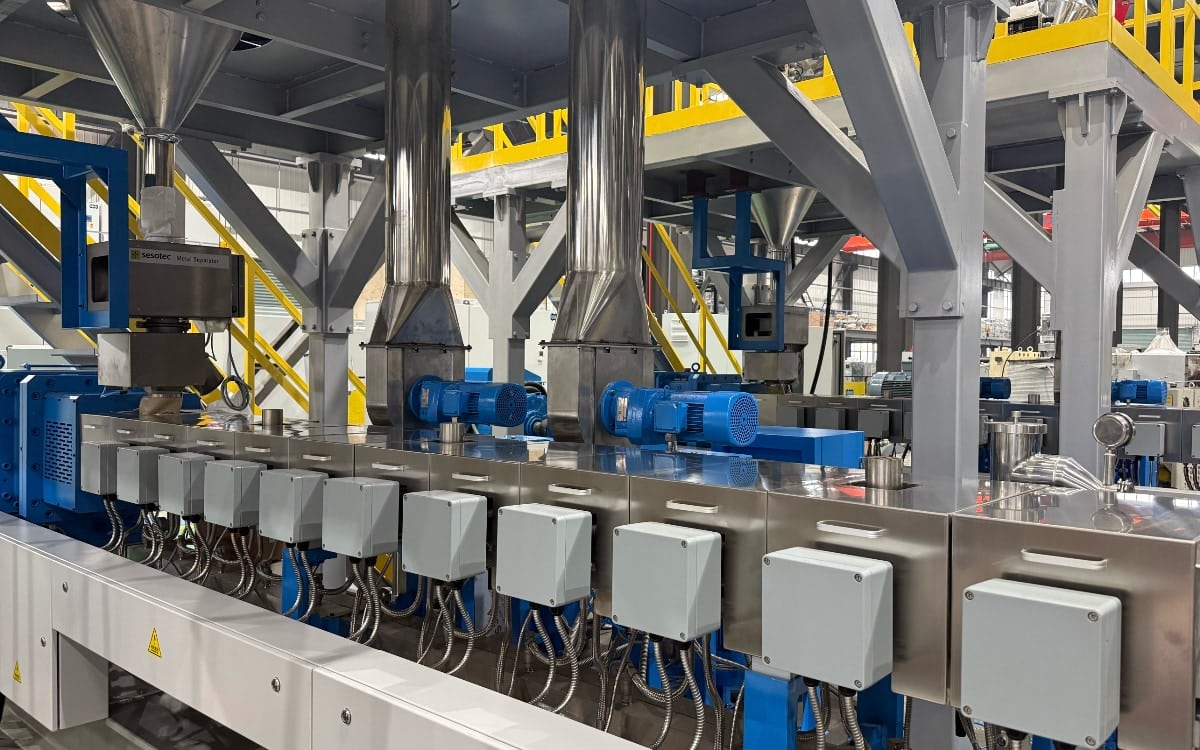
So, what does 35–40% talc loading truly test in a twin-screw extruder?
The most immediate impact is the non-linear surge in load. When 3000-mesh fine powder meets the PP matrix, the immense specific surface area causes the melt viscosity to “thicken” instantaneously.
This leads to an engineering paradox:
- Boosting throughput requires high RPM: However, high speeds cause the shear heat in the PP to skyrocket, leading to material degradation, yellowing, and a complete loss of performance properties.
- Controlling melt temperature requires low RPM: Yet, as soon as the speed drops, the torque hits the ceiling (Torque Limited), potentially causing the machine to “stall” or shut down completely.
On the production floor, this typically manifests as four headache-inducing scenarios:
- Sustained High Load: The equipment must endure high loads continuously, not just as short-term peaks.
- Sensitivity to Fluctuations: Even tiny variations in feeding are amplified into significant fluctuations in torque and current.
- Process Bottlenecks: Due to the high air content in fine powders, side feeding and degassing become the critical bottlenecks for process stability.
- Wear & Tear: Long-term abrasion gradually compromises the system’s precision and operational stability.
Solution Strategy
Not “Brute Force,” But “System Stability”
For this specific system, our recent successful practice can be summarized as: “Reserve torque margin, provide an exit for gas, and optimize material conveying.”
1) 18.5 Nm/cm³ Specific Torque: Not a Gimmick, But the Foundation for Stability
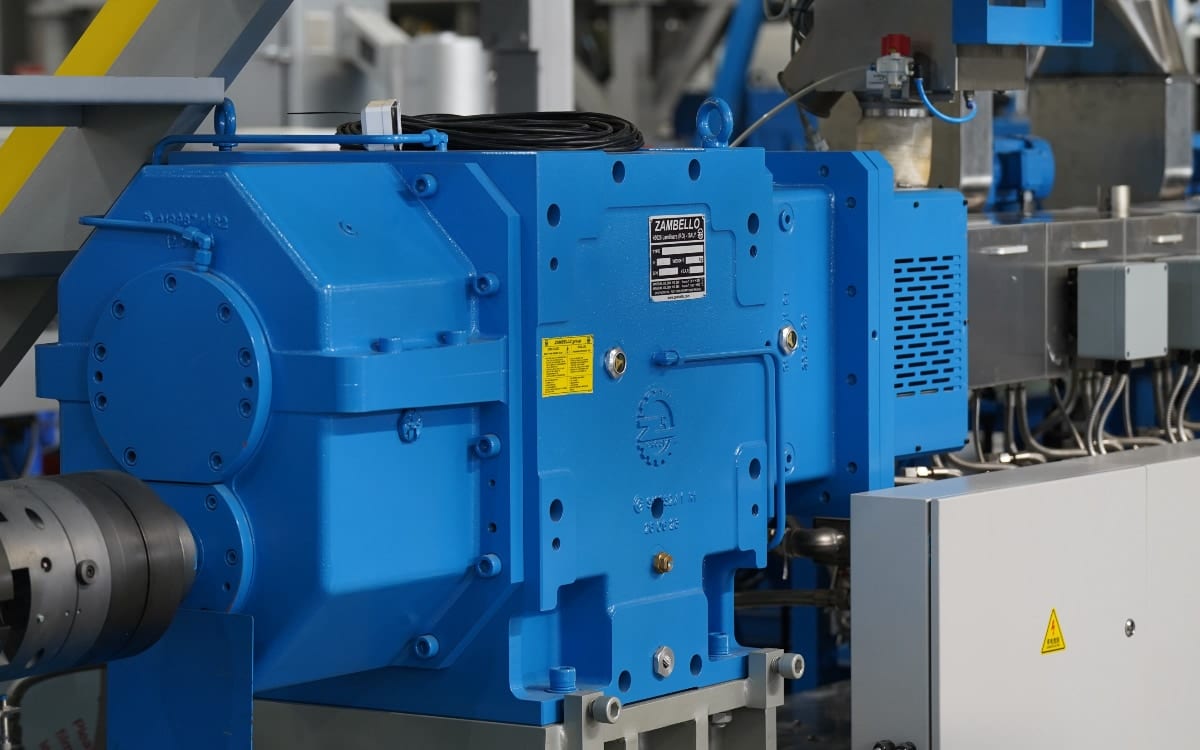
We utilized an imported gearbox capable of a high specific torque of 18.5 Nm/cm³. This allows the machine to maintain a reasonable RPM even under high-loading conditions. This approach ensures sufficient extrusion pressure while keeping the shear heat buildup well within the tolerance limits of the PP matrix.
2) "Vacuum + Water-Cooled Side Feeding & Side Degassing": Solving the Process Bottleneck
3000-mesh talc has a low bulk density and high air content. If the entrapped air is not evacuated in time, it amplifies load fluctuations and disrupts extrusion continuity. By synergizing a vacuum-assisted, water-cooled side feeder with a side degassing unit, we achieved:
- Continuous and stable introduction of high-loading, fine fillers.
- Effective removal of air entrained in the powder and volatiles in the melt.
- Significant reduction in torque fluctuation.
3) Structural Design Logic: Balancing Mixing and Lifespan
We optimized the screw configuration. Instead of blindly pursuing aggressive shear elements, we utilized specially designed screw elements to achieve high dispersion. Meanwhile, tougher wear-resistant materials were adopted in critical zones to ensure precision can withstand long-term high loads.
Validation Results
Stable Operation and Capacity Realization.
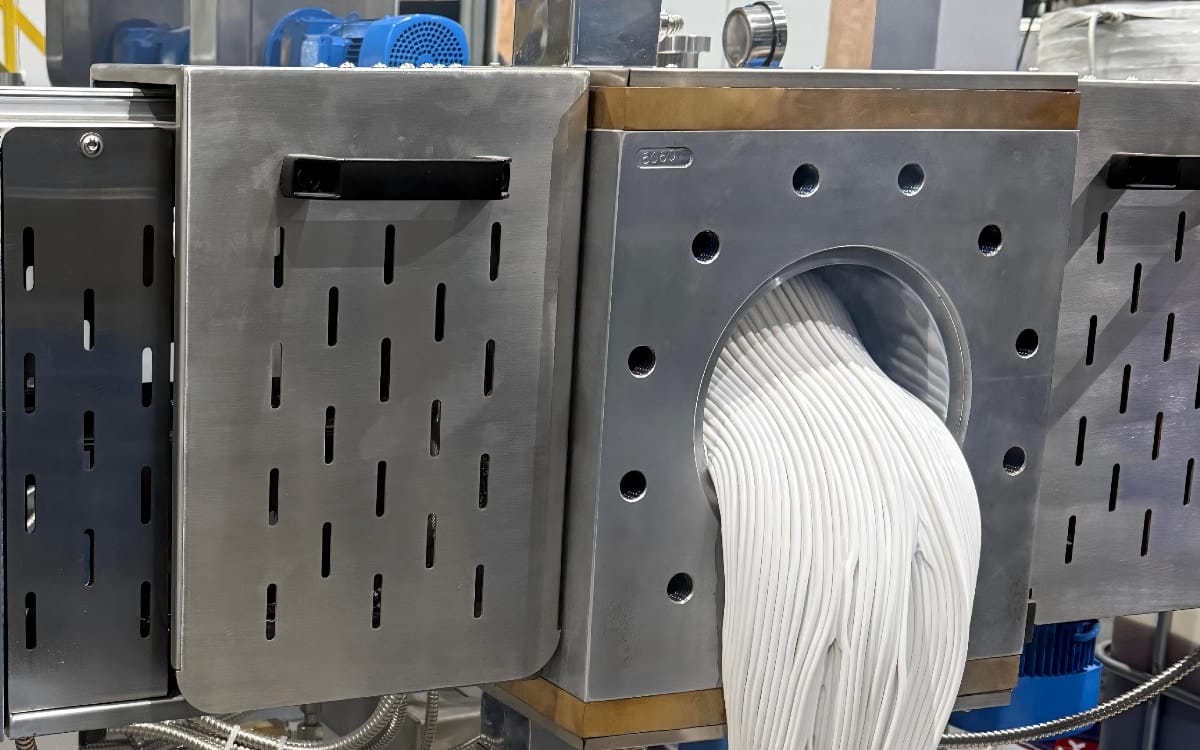
During on-site process validation, this talc-filled system successfully completed start-up, steady-state operation, and full-capacity testing.
The system operation was stable and controllable. The overall performance met the customer’s acceptance criteria and provided a reliable basis for future capacity planning.
Project Video
Conclusion
This practical application demonstrates that in high-fineness, high-loading systems, the challenges cannot be solved by a single parameter. It is a matter of system matching involving torque reserve, feeding stability, side-feeding capability, and wear-resistant structure.
Our engineering experience sums it up as: “Torque reserve is the foundation, stability is the core, and wear resistance is the guarantee.” Rather than constantly operating on the jagged edge of failure, it is better to widen the processing window through systematic equipment configuration.
Only when the equipment can operate smoothly within the load range over the long term can the economic benefits of high-filling modification be truly realized.