
In modified plastics compounding, increasing calcium carbonate (CaCO₃) loading in a polypropylene (PP) matrix from 75% to 80%—and further toward 85%— is not a simple incremental adjustment, but a fundamental process challenge.
Unlike PE, PP molecular chains are significantly more sensitive to shear-induced thermal degradation. Under ultra-high filler conditions, excessive local shear heat can easily trigger chain scission, resulting in abnormal MFI increase, unstable melt strength, pelletizing difficulties, and even strand breakage.
Based on extensive industrial delivery experience from USEON, this article systematically dissects the engineering logic behind stable PP ultra-high filler compounding from four decisive dimensions: material engineering, feeding strategy, screw design, and process control.

Why PP High-Filling Above 80% Becomes Fundamentally Difficult
When filler content exceeds 80%, the formulation shifts into an extreme regime:
- The polymer fraction becomes the minority phase (< 20%).
- The melt must wet, encapsulate, and transport a massive volume of mineral particles.
- Internal friction and shear heat rise exponentially.
In this condition, traditional compounding logic that works for PE or moderate PP filling often fails. Achieving stability is no longer about “more shear,” but about controlling how and where shear energy is generated.
Material Engineering: More Than Particle Size
Successful PP high-filler processing starts long before the powder enters the extruder. Beyond nominal mesh size, three powder characteristics critically determine process stability.
Particle Size Distribution & Oil Absorption
For PP systems, heavy calcium carbonate with D50 ≈ 2–4 μm is generally recommended. While ultra-fine powders may improve stiffness, their extremely high specific surface area dramatically increases oil absorption (DOP value). This sharply elevates melt viscosity and often leads to main motor over-torque.
Surface Treatment Quality
At filler levels above 80%, effective surface treatment becomes mandatory rather than optional.
- Untreated CaCO₃ exhibits poor compatibility with non-polar PP, causing high internal friction, rapid screw wear, and poor mechanical performance.
- Properly Treated Powder (stearic acid or aluminate coupling agents, coating rate >98%) significantly reduces system viscosity and friction heat—forming the physical basis for ultra-high filling without degradation.
Powder Flowability
High-mesh CaCO₃ powders are prone to bridging. If the angle of repose exceeds ~45°, conventional single-screw feeding becomes unreliable.
For such systems, a twin-screw loss-in-weight feeder equipped with vertical agitation and arch-breaking design is essential to maintain feeding accuracy and continuity.
Feeding Strategy: Why Split Feeding Is Not Optional
For extreme formulations such as PP 15% + CaCO₃ 82–85% + additives, attempting “all-in-one” feeding is a common and costly mistake.
Recommended Split Feeding Concept
Main Feeder
- Content: 100% PP resin + Internal/External lubricants (PP-Wax, EBS).
- Engineering Logic: Allow PP to melt completely and form a continuous, low-viscosity carrier phase before powder introduction. Early lubricant addition helps suppress friction-induced heat generation during downstream mixing.
Side Feeder
- Content: 100% mineral filler introduced mid-barrel (typically zones 4–5).
- Advantage: At this stage, fully molten PP rapidly wets the powder, preventing destructive dry friction between mineral particles and screw elements.
Air Management at the Side Feed
Ultra-fine CaCO₃ powder can contain entrained air exceeding 70% of its apparent volume. A side feeder combined with a vented inner liner enables reverse air discharge at the feeding port, preventing pressure instability and material back-flow.
Screw Design Logic: Why L/D 52 Matters for PP
PP offers a narrower thermal processing window than PE. Screw configuration must therefore balance sufficient dispersion with strict temperature control. Using an L/D 52 platform, a more controlled and extended processing history becomes possible.
Melting Section
Use large-lead conveying elements combined with 30° / 60° kneading blocks to ensure rapid and uniform PP melting without excessive shear.
Mixing & Dispersion Section (Downstream of Side Feeder)
- Elements: 45° kneading blocks (KB45/5/42) and ZME / SME toothed mixing elements.
- Core Principle: Distributive mixing over aggressive dispersive shear. Toothed elements repeatedly divide and redistribute agglomerates, achieving uniform dispersion while avoiding local temperature spikes.
- Caution: Excessive use of 90° kneading blocks should be avoided, as they significantly increase shear heat and accelerate PP molecular degradation.
Degassing Strategy
L/D 52 allows the integration of 2–3 venting sections, typically:
- 1 Natural Vent
- 2 Vacuum Vents (Vacuum level ≥ –0.08 MPa)
Efficient degassing removes residual air and low-molecular volatiles, ensuring dense, pore-free pellets.
When Twin-Screw Reaches Its Limit: The Tri-Screw Advantage
As PP filler content approaches 85%, or when dispersion requirements become extremely stringent (e.g., FPV-critical masterbatches), conventional twin-screw systems may approach their physical limits. In such cases, Tri-screw architecture provides a structural solution.
Structural Advantages
- Multiple Intermeshing Zones: Create higher effective shear frequency per revolution.
- Low-Temp Dispersion: Enhanced surface renewal enables efficient dispersion at lower screw speed and melt temperature.
Industrial comparisons show that under equivalent torque conditions, tri-screw systems can achieve 10–15°C lower melt temperature in PP + 84% CaCO₃ formulations, significantly preserving molecular integrity.
Proven Industrial Applications
The following data originates from USEON’s long-term industrial production lines and reflects stable mass-production performance.
| Region | Configuration | Formula | Key Parameters | Performance |
|---|---|---|---|---|
| China | Tri-screw 75 (L/D 52) | PP + 84% CaCO₃ | Split feeding Vacuum –0.09 MPa | Excellent dispersion, smooth pellet surface. |
| Hong Kong, China | Twin-screw 75 (L/D 52) | PP + 83% CaCO₃ | 800 rpm Dual vacuum | High-throughput benchmark. |
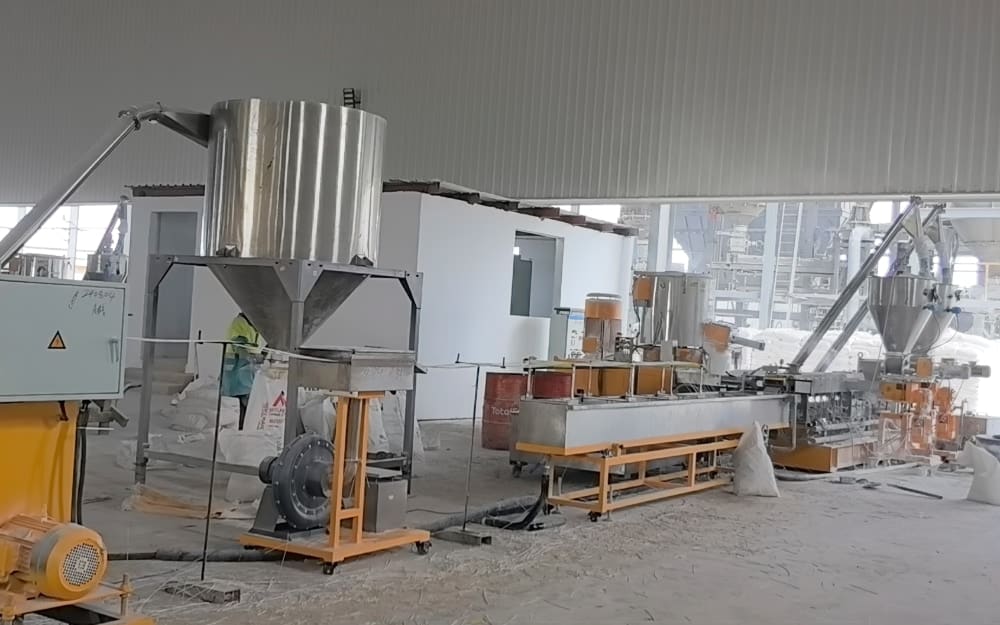
| Tanzania | Twin-screw 65 (L/D 52) | PP + 81.5% CaCO₃ | Loss-in-weight feeding | Stable continuous operation in high ambient temp. |
| Turkey | Twin-screw 65 (L/D 48) | PP + 80% CaCO₃ | Water-ring pelletizing | Improved pellet integrity and shape. |

Engineer FAQ: Typical PP High-Filling Issues
A: This is a clear sign of PP thermal degradation (chain scission) caused by excessive shear heat.
- Action: Reduce aggressive shear elements (like 90° kneading blocks), lower mid-barrel temperature, and increase external lubrication.
A: Single-screw feeding cannot overcome air back-pressure at extreme powder loading. Twin-screw side feeders physically force powder forward while enabling air discharge through a vented liner.
A: PP crystallizes fast, but high filler loading reduces melt strength, causing strands to break or stick.
- Action: Adjust water-ring cutter gap (< 0.05mm), optimize die face temperature to prevent hole freezing, and ensure cooling water is not too cold (avoiding shock cooling).
A: Processing 80%+ CaCO₃ with standard nitrided steel causes rapid abrasion.
- Action: Upgrade to bimetallic wear-resistant elements (e.g., WR13 or HIP powder metallurgy) in the mixing zones. Their lifespan is typically 3–5 times longer than standard steel.
A: Usually caused by insufficient degassing of entrained air or moisture in the powder.
- Action: Ensure vacuum levels ≥ –0.08 MPa, utilize L/D 52 for extended natural degassing, and check for obstructions in the side feeder venting.
A: The primary advantage is “Low-Temperature Dispersion.”
- Explanation: For heat-sensitive PP, the tri-screw achieves equivalent dispersion at lower RPMs and lower melt temperatures due to its extra intermeshing zones. It is the ideal solution if preserving PP molecular weight is critical.
Conclusion: PP High-Filling Is an Engineering System
Ultra-high filler PP compounding is not solved by higher torque alone. It requires coordinated optimization of powder characteristics, feeding strategy, screw geometry, and thermal control.
With high-torque platforms, extended L/D design, and application-driven screw engineering, stable PP compounding beyond 80–85% filler becomes a controllable and repeatable industrial process.