
1,500 kg/h PP Recycling Pelletizing Solution: FAT Success of SAT110 Twin-Screw Line for India
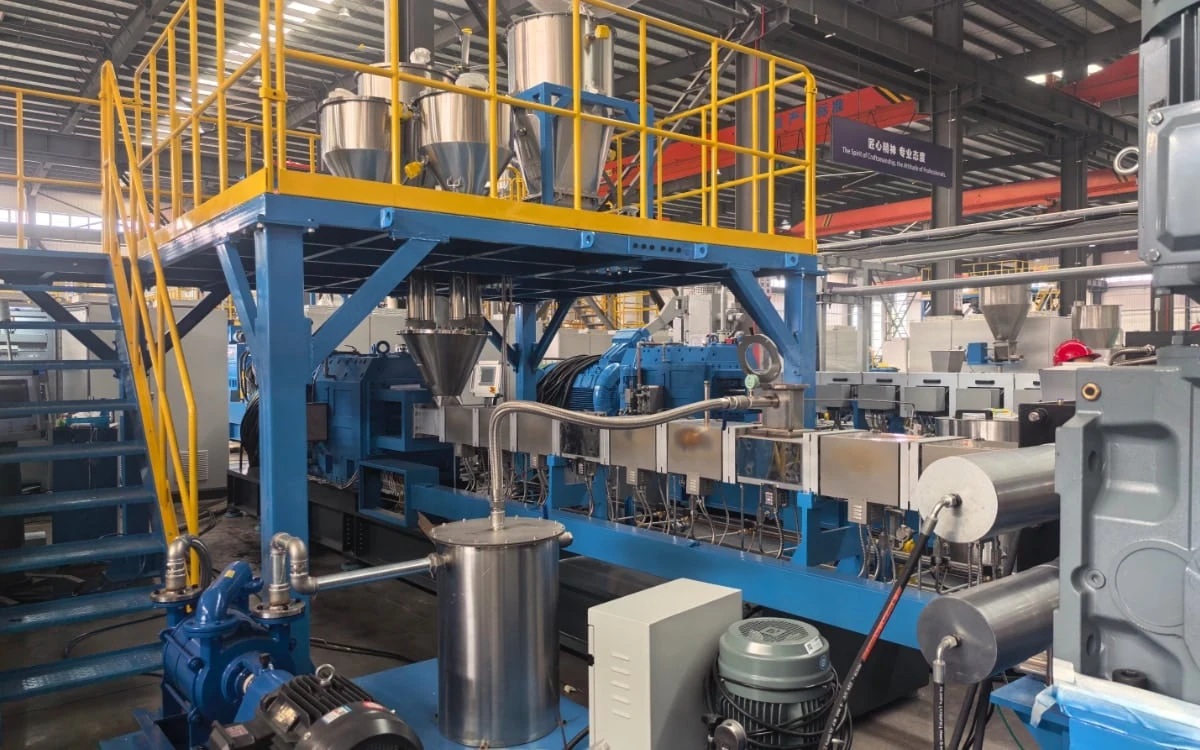
A SAT110 twin screw line with underwater pelletizing, compounding crushed PP recyclate with virgin PP and additives at about 1500 kg/h.
Project Background
Tailored specifically for the rapidly expanding plastics recycling and compounding market in India, this customized solution is designed to tackle the customer’s core production challenge: achieving a high-capacity, uniform compounding of recycled PP crushed material with virgin PP and various liquid/powder additives.
Due to the inherent physical disadvantages of recycled plastics—such as inconsistent bulk density, high moisture content, and fluctuating Melt Flow Index (MFI)—coupled with the customer’s strict demand for a ~1500 kg/h throughput, the project urgently required a top-tier extrusion system featuring powerful plasticizing shear, deep devolatilization, high-precision filtration, and an adaptive pelletizing capability.
Material Characteristics & Challenges
Processing Instability of PP Crushed Recyclate
Recycled materials easily entrap moisture and impurities, causing bridging in the feeding zone. Their unstable Melt Flow Rate (MFR) directly causes significant pressure fluctuations at the extruder die, severely affecting pellet uniformity.
Challenges in Multi-Component Dispersive Mixing
The viscosity difference between virgin PP and newly introduced additives (including liquid additives) demands an extremely precise screw profile configuration to provide robust distributive and dispersive mixing to prevent additive agglomeration.
Melt Filtration Interference
Recycling-grade plastics contain unmelted particles or inorganic impurities. Without efficient interception, these easily block the die micro-holes and cause hard chipping on the underwater pelletizing blades.
USEON Solution
Robust Extruder Drive Configuration
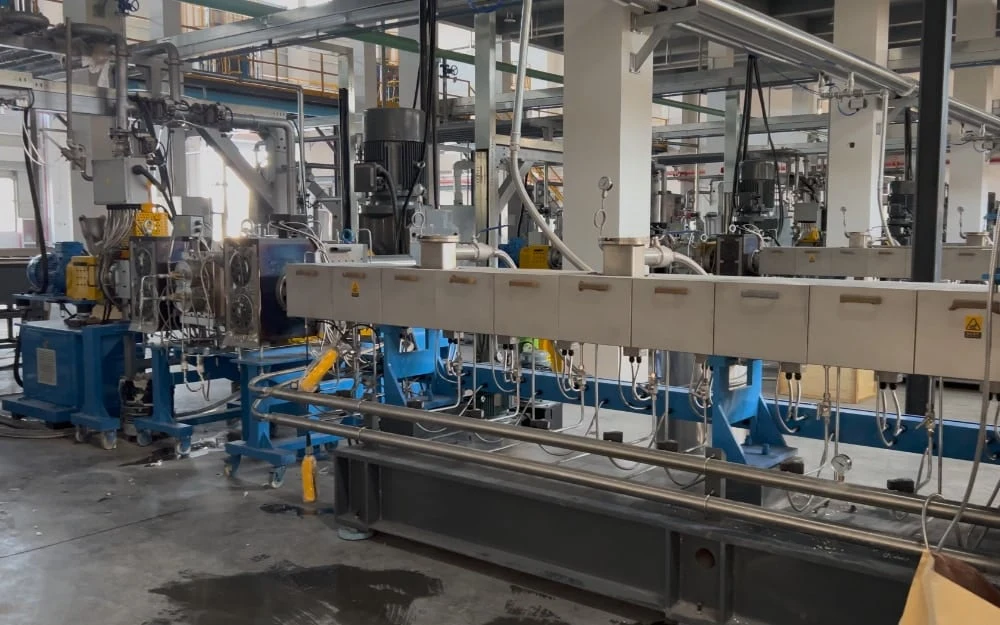
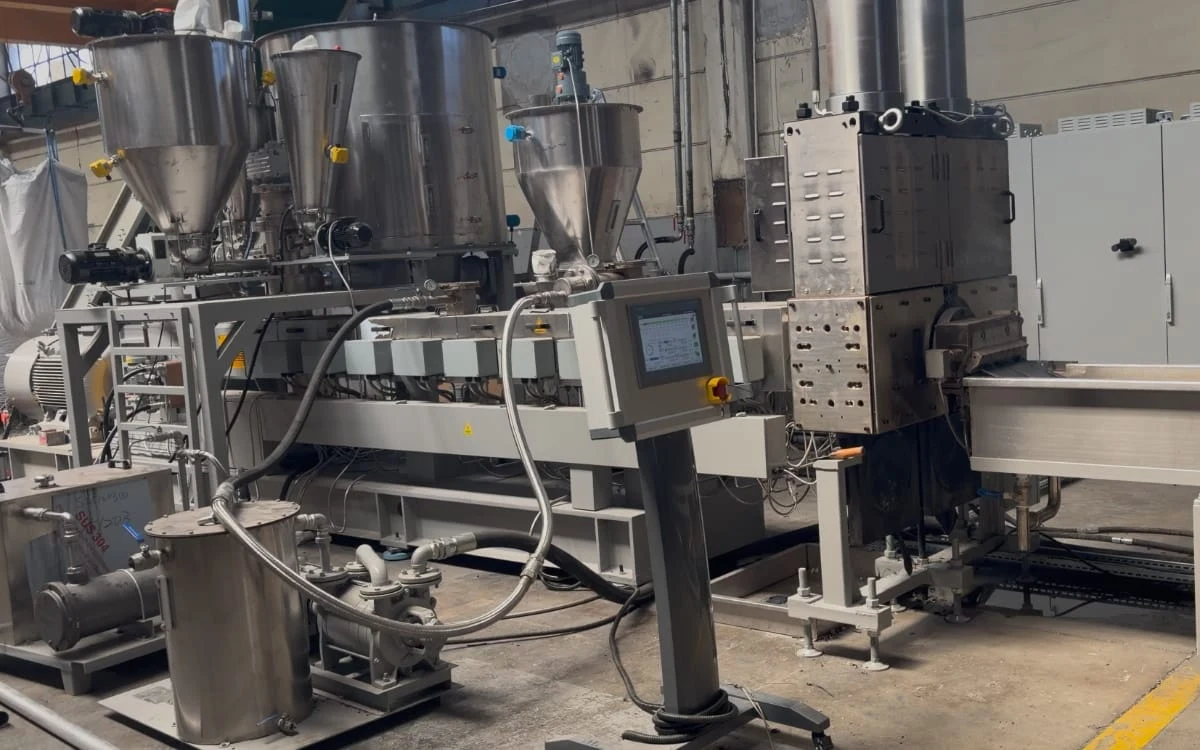
The system employs the SAT110 twin-screw main extruder, featuring the classic L/D=40 golden ratio and a Siemens 500Kw IE3 high-efficiency motor. Its broad speed range of 60–400rpm provides effortless shear rate control for different modified PP formulations.
Precision Filtration and Pressure Stabilization
Equipped with a double-pillar continuous screen changer boasting a 3000CM² filtration area to powerfully intercept recyclate impurities. Furthermore, a 1000CC displacement melt pump with a closed-loop feedback control system is strategically integrated to re-stabilize the pressure of the filtered melt, ensuring pulsation-free discharge.
Efficient Devolatilization and Liquid Injection
Multi-stage vacuum venting stations with a two-stage water-ring vacuum pump are equipped on the 5th and 8th barrel sections to thoroughly extract volatiles and moisture. A variable-frequency liquid injection system ensures precise, proportional integration of additives.
Superior Underwater Pelletizing System
Deploys a high-end underwater pelletizer utilizing a 15KW variable-frequency motor and a hydraulic automatic blade adjustment device. The wear-resistant alloy steel die plate and vacuum-quenched high-speed tool steel blades ensure not only stable cutting but also perfect, spherical pellets.
To address these challenges, USEON demonstrated several targeted technical configurations on the SAT110 (L/D 40:1) line during the acceptance tests:
Project Video
Summary
Following rigorous FAT (Factory Acceptance Testing) by the USEON engineering team, this production line successfully achieved its stable throughput target of 1500 kg/h. When handling complex formulations containing crushed materials, the system demonstrated extremely low melt pressure fluctuation. The underwater pelletized granules were uniform in size with no “tails” or adhesion, and the dehydrated material fully met the customer’s high-end injection molding application requirements.
The system is now approved and ready for shipment to India, providing solid backing for the customer’s global capacity expansion.
FAQ
How to choose the most suitable pelletizing system when processing PP compounding with recycled materials?
A: We strongly recommend an underwater pelletizing system. Because melt viscosity and strength vary between recyclate batches, using a traditional strand pelletizer easily leads to frequent "strand breakage" during water bath stretching. Underwater pelletizing technology cuts the high-temperature melt immediately in a constant-temperature water chamber using rotating blades the moment it exits the die, completely eliminating the risk of strand breakage. The resulting pellets are round (spherical or lens-shaped) with better flowability, vastly improving the feeding stability for downstream injection molding customers.
When processing high-moisture and high-impurity crushed PP recyclate, how do you solve production issues like "bubbles" and "yellowing degradation" in final products?
A: The core countermeasure is a combination of multi-stage powerful devolatilization and fine-tuned temperature control. We designed multiple vacuum venting chambers on specific barrel sections of the main extruder, connected to a powerful two-stage water-ring vacuum pump (15KW). This provides deep, high vacuum to instantly extract moisture and low-molecular-weight degradation products. Simultaneously, precise Siemens PLC closed-loop temperature control prevents localized overheating inside the barrel, effectively eliminating yellowing and porosity.
Why is a "Melt Pump" mandatory in this type of high-capacity recycling and compounding SAT110 system?
A: A twin-screw extruder is an excellent compounding device, but not a perfect pressure-building pump. When processing recipes with crushed material, feeding fluctuations cause unstable pressure building at the front end. By installing a melt pump in series, the twin screws are relieved from the burden of high-pressure output, allowing them to focus on mixing. The melt pump then takes over to deliver a stable, pulsation-free high pressure to force the material into the underwater pelletizing die. This is the underlying physical guarantee to ensure uniform pellet size and prevent localized die blockages.
India has high temperatures year-round. How do you prevent the underwater pelletizing water temperature from overheating during continuous full-load operation and ensure blade lifespan?
A: To address the challenges of a high-temperature environment, we equipped the water circulation system with a large 1450L water tank and a powerful 11KW water circulation pump to ensure sufficient cooling water flow and thermal buffering capacity. For the cutting system, the die head utilizes a customized wear-resistant alloy steel die plate, paired with a 12-blade pelletizer driven by a 15KW motor running at 3000r/min. Furthermore, the system features a hydraulic reversing start valve. These solid hardware configurations collectively ensure cutting stability and system longevity under continuous high-load operation.
Get a quote
Tell us your material, formulation and target throughput.
- 01Process review
- 02Engineer call
- 03Line proposal

Souder Chen
Head of Compounding Division
With USEON since 2008. Twin screw compounding, devolatilization and recycling lines.