
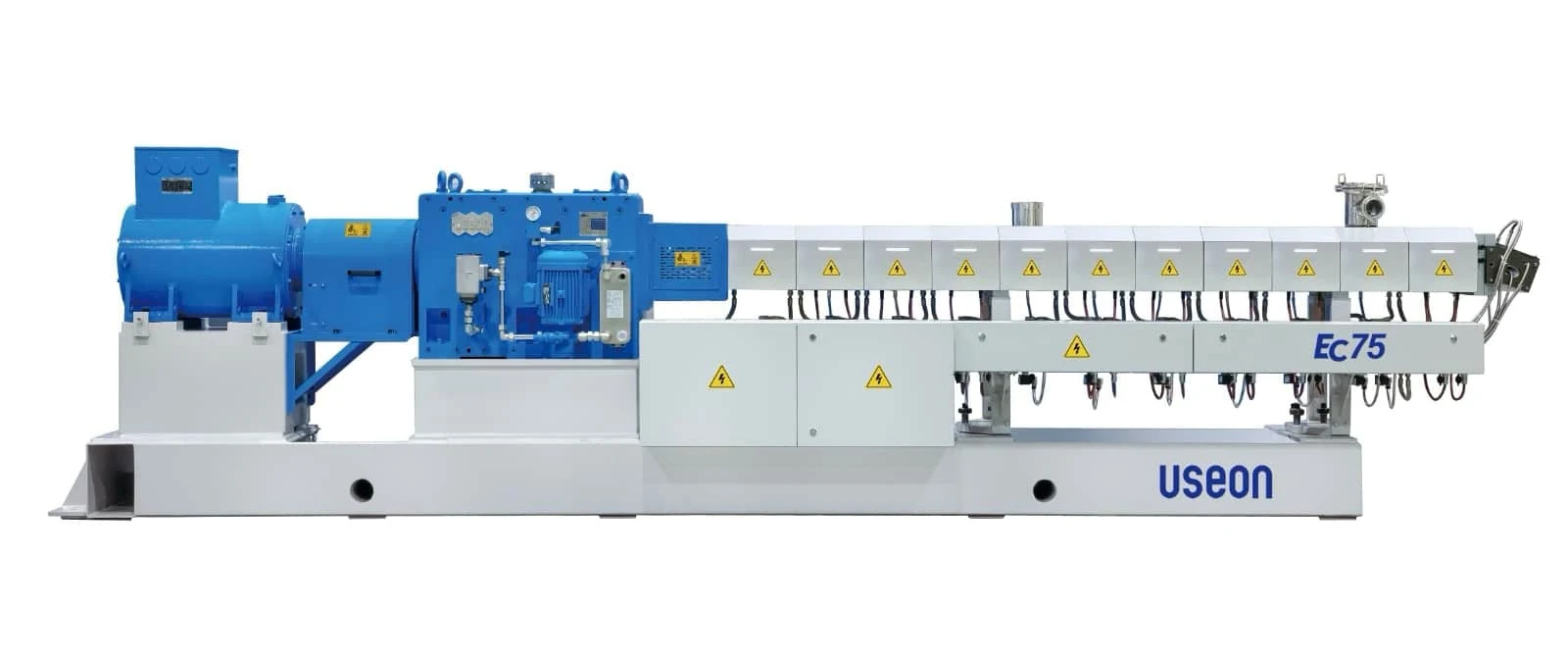
EC Twin Screw Extruder
The EC series is purpose-built for small to medium-scale manufacturing and designed with your production costs in mind. A high-efficiency permanent magnet motor and optimized transmission and heating systems reduce energy consumption by approximately 15% compared to traditional extruders.
- Lower energy consumption than traditional extruders
- ~15%
- Screw diameter, EC 26 to EC 75
- 26.5–71mm
- Output, by size and material
- 10–800kg/h
Design features
The intelligent control system is adapted from our large-scale production lines. With real-time energy monitoring and key parameter tracking, equipment status is clear at a glance.
EC or SAT at the same screw diameter
Three sizes exist in both series. The EC installs less power and runs at a lower output.
EC55 kW · 150–250 kg/h
SAT132 kW · 350–500 kg/h
EC90 kW · 300–400 kg/h
SAT220 kW · 500–900 kg/h
EC160 kW · 600–800 kg/h
SAT280 kW · 700–1,200 kg/h
Motor power and output from the model tables of the two series. Bar length is motor power.
Choose the EC when
Standard torque is enough
For color masterbatch and general compounding where extreme torque is not necessary, in small to medium-scale production up to 800 kg/h.
Choose the SAT when
SAT Series
For heavy filler loads, glass fibre reinforcement and outputs above 800 kg/h.
SAT Series- Co-rotating
- Counter-rotating
Technical data sheet
| EC Series | Diameter [mm] | Max. Speed [rpm] | Motor [kW] | Output [kg/h] |
|---|---|---|---|---|
| EC 26 | 26.5 | 600 | 7.5 | 10–30 |
| EC 35 | 35.6 | 600 | 18.5 | 20–80 |
| EC 52 | 51.4 | 600 | 55 | 150–250 |
| EC 65 | 62.4 | 600 | 90 | 300–400 |
| EC 75 | 71 | 600 | 160 | 600–800 |
Output depends on the material and the formulation.
Get a quote
Tell us the material and the output. We check whether the EC covers the job or the SAT is the better fit, and quote the line.
- 01Material and formulation
- 02Target output and pelletizing method
- 03EC size, configuration and quotation

Souder Chen
Head of Compounding Division
With USEON since 2008. Twin screw compounding, devolatilization and recycling lines.