
3D Printer Filament Extrusion Line
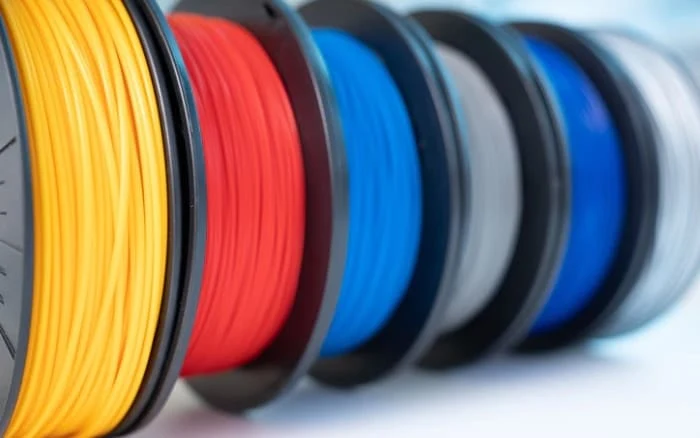
A 3D printer filament extrusion line turns PLA, ABS, PETG, ASA, HIPS or PVA, with colour masterbatch, into 1.75 mm or 2.85 mm filament on spools. USEON builds it on a TDD single screw extruder in three sizes, 2–30 kg/h, with hot-water forming, laser diameter control, an accumulator and automatic winding.
- 1.75 or 2.85 mm
- Laser diameter control
- Non-stop spool change
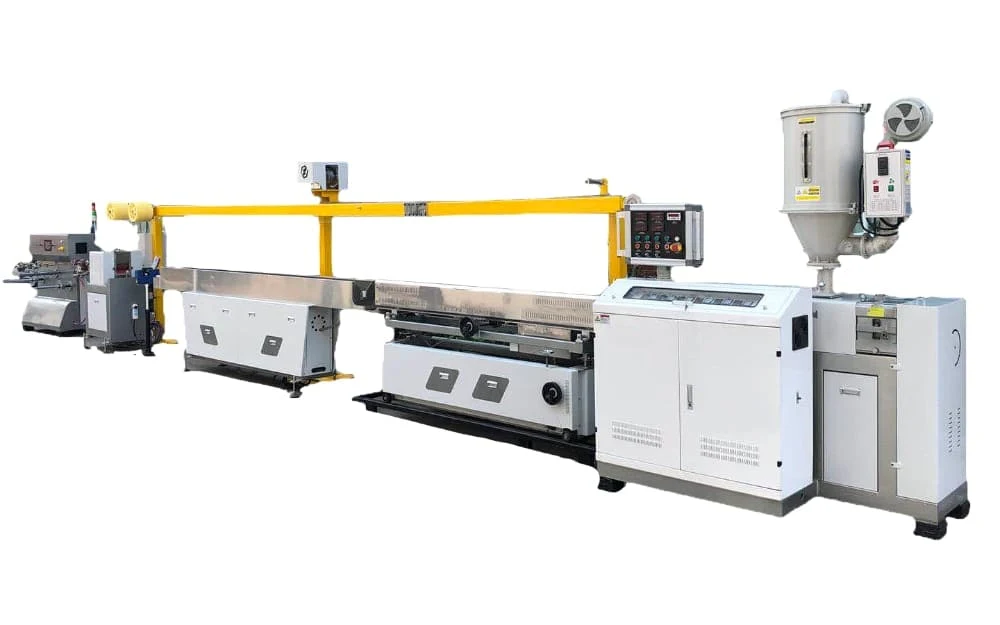
How a 3D printer filament extrusion line works
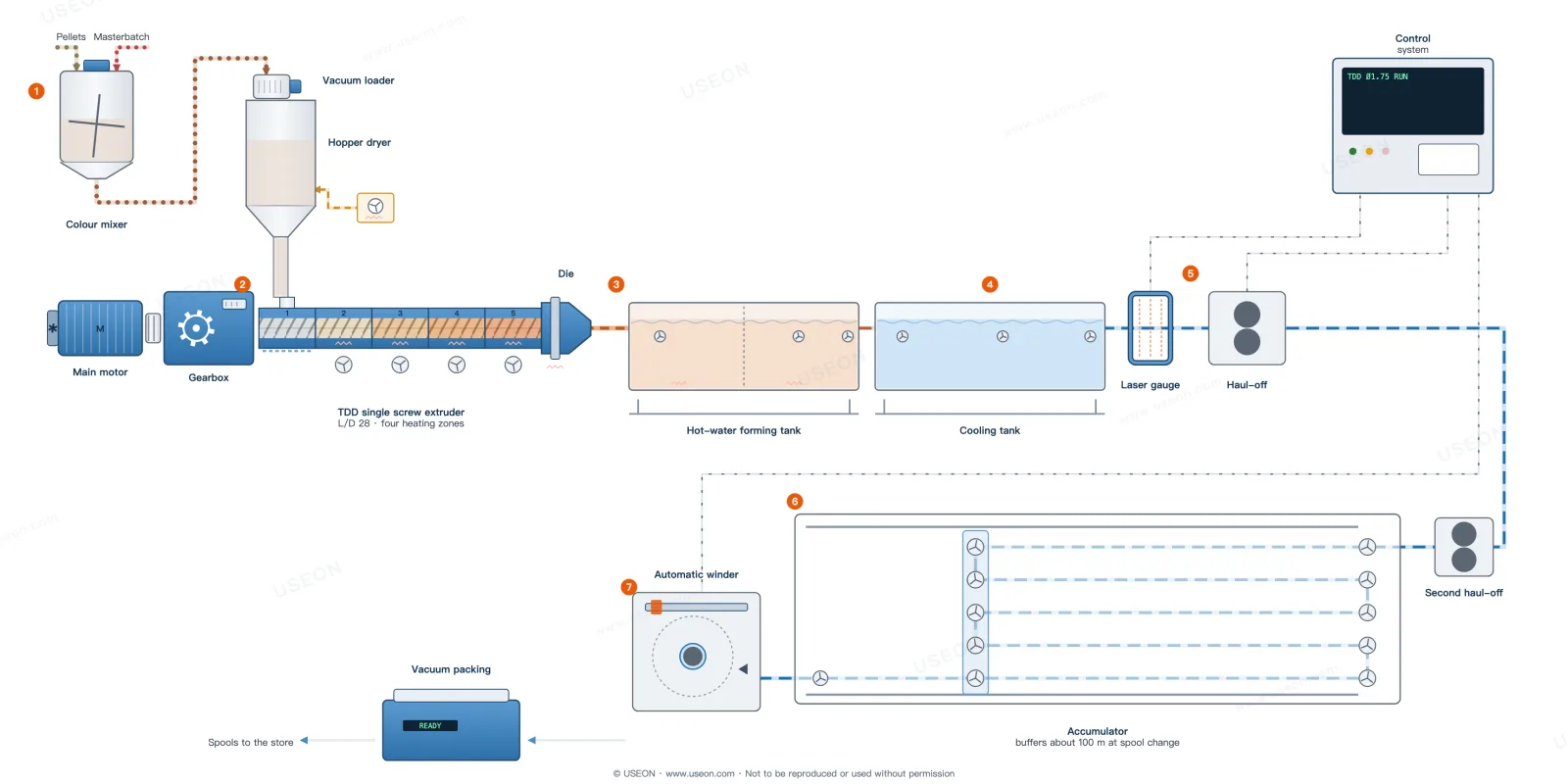
3D printer filament is made by drying plastic pellets, melting them in a single screw extruder, drawing the melt to size through hot and cold water, measuring it with a laser gauge and winding it onto spools. A USEON line does this with thirteen units in seven stages, from the colour mixer to vacuum packing: the extruder makes the melt, and everything after the die holds the diameter.
Process flow · TDD-45 line
 Open interactive diagram
TDD-45Single screw · L/D 28+1.75mm filament
Drawn as a TDD-45 production line. The TDD-25 and TDD-30 use the same flow; the final configuration depends on your material and output.
- 01
Mixing, loading and drying
Pellets and colour masterbatch are mixed to the recipe and vacuum-loaded into a hopper dryer. Hot air takes the moisture out before the extruder; wet PLA or PETG degrades in the melt and forms bubbles.
- 02
Single screw extruder
A TDD single screw extruder melts and compresses the pellets and feeds the die evenly. The feed section is water-cooled, and each heating zone along the barrel has its own heater and fan, so the melt temperature holds steady.
- 03
Die and hot-water forming
The melt leaves a round die that is wider than the filament, and the haul-off draws it down to size. The filament first sets in the hot-water forming tank, which cools it slowly, so it stays round with little internal stress.
- 04
Cooling tank
Circulating cold water cools the filament right through, so its diameter is stable before it is measured.
- 05
Laser gauge and haul-off
A laser gauge measures the diameter continuously. The PLC corrects the servo haul-off speed from the reading in a closed loop: faster draws the filament thinner, slower lets it thicken.
- 06
Accumulator
A second haul-off feeds a horizontal accumulator. While the spool is changed, it buffers about 100 m of filament, so the extruder does not stop.
- 07
Winding and vacuum packing
The automatic winder lays the filament turn by turn and follows the line speed. At the set length it cuts the filament, and the next spool is clamped quickly on a pneumatic chuck; each full spool is vacuum-sealed against moisture.
Opens the process flow at this stage
Control system
A PLC controls the line: zone temperatures, screw speed and diameter are set and shown at the control cabinet. The gauge reading sets the haul-off speed, and the winder follows the line speed.
Filament extruder models: TDD-25, TDD-30, TDD-45
The filament extruder comes in three sizes: TDD-25 (2–4 kg/h, for trials), TDD-30 (5–10 kg/h) and TDD-45 (15–30 kg/h, for production). Every size makes 1.75 mm or 2.85 mm filament; output depends on material and diameter, and the TDD-45 makes about 15–25 kg/h of 1.75 mm filament.
| Model | Screw Dia. (mm) | Motor (kW) | Filament Dia. (mm) | Output (kg/h) |
|---|---|---|---|---|
| TDD-25 | 25 | 1.5 | 1.75 or 2.85 | 2–4 |
| TDD-30 | 30 | 7.5 | 1.75 or 2.85 | 5–10 |
| TDD-45 | 45 | 11 | 1.75 or 2.85 | 15–30 |
Planning a TDD-45 line
About 15 × 1.5 m of floor
A TDD-45 line needs about 15 × 1.5 m of floor and 2.5 m of height, depending on the layout. We send a layout for your hall.
One 40 ft container
The complete line ships in a single container, in export wooden cases.
Power, water and air
About 35 kW installed, about 15 kW in use. Tap water for the tanks; compressed air at 4–8 bar from your own compressor.
Sizing the line
We size the extruder to your material and output, then the forming, gauging and winding.
Remote support
Our engineers support you remotely, from start-up to daily production.
Spare parts
A starter set of spare parts and tools ships with the line; more on request.
Filament materials: PLA, ABS, PETG, ASA, HIPS and PVA
Each material decides how you dry, cool and wind the filament. All of them take colour masterbatch, and PLA/PBAT blends run too.
| Material | On your filament line | For the printer user |
|---|---|---|
| PLA | Dry before extrusion: moisture degrades PLA in the melt, causing bubbles and diameter swings. Keep winding tension even, because the filament snaps rather than stretches. | Hardly shrinks, so large parts print even on open printers. Brittle, and softens above about 60 °C. For models, prototypes, boxes and gifts. |
| ABS | Dry before extrusion. Cool gradually — hot-water forming tank, then the cooling tank — so the filament stays round and free of internal stress. | Tough and heat resistant. Shrinks on cooling, so it warps without an enclosure; print in a ventilated room. |
| ASA | Dry before extrusion and cool gradually, as for ABS. | Weather- and UV-resistant, for parts used outdoors. Like ABS, it warps without an enclosure. |
| PETG / PET | Dry thoroughly before extrusion; PETG and PET pick up moisture and lose viscosity in the melt. | Tough, low shrinkage, good layer adhesion. |
| HIPS | Runs much like ABS. | Similar to ABS; also used as a support for ABS prints that dissolves in limonene. |
| PVA | Dissolves in water, so a PVA line needs dry cooling in place of the water tanks, and sealed, dry packing. | Water-soluble support material. |
Filament diameter tolerance is what printer users notice first, so tell us your target together with the material.
FAQs
How is 3D printer filament made?
Plastic pellets and colour masterbatch are dried and melted in a single screw extruder. The melt is drawn to size through a hot-water forming tank and a cooling tank, a laser gauge corrects the diameter through the haul-off speed, and an automatic winder fills the spools, which are then vacuum-sealed.
What does a 3D printer filament extrusion line consist of?
Thirteen units: colour mixer, vacuum loader, hopper dryer, single screw extruder, die, hot-water forming tank, cooling tank, laser diameter gauge, haul-off, second haul-off, accumulator, automatic winder and vacuum packing machine, under PLC control.
Can one line make 1.75 mm and 2.85 mm filament?
Yes. The die nozzle can be changed, so one line makes both standard diameters, 1.75 mm and 2.85 mm; 2.85 mm filament is often sold as 3 mm.
How does a filament line hold the diameter?
A laser gauge after the cooling tank measures the diameter continuously, with 0.001 mm resolution, and the PLC corrects it through the haul-off speed. The tolerance you reach also depends on the material and how well it is dried; tell us your target.
What output does a filament extruder have?
It depends on the line size, the material and the diameter: 2–4 kg/h on the TDD-25, 5–10 kg/h on the TDD-30 and 15–30 kg/h on the TDD-45, with screw diameters of 25, 30 and 45 mm. At 1.75 mm the TDD-45 makes about 15–25 kg/h.
Which materials can a filament extrusion line process?
PLA, ABS, PETG, ASA, HIPS and PVA, mixed with colour masterbatch, and PLA/PBAT blends. PVA dissolves in water, so a PVA line needs dry cooling in place of the water tanks.
Can a filament line change spools without stopping?
Yes. At the set length the winder cuts the filament and the next spool is clamped on a pneumatic chuck, while the accumulator buffers about 100 m of filament, so the extruder keeps running.
Why must PLA and PETG be dried before extrusion?
Moisture degrades them in the melt. In PLA it causes bubbles and diameter swings; PETG loses viscosity. The hopper dryer before the extruder removes the moisture, and vacuum packing keeps the finished spools dry.
How is carbon fibre or filled filament made?
It starts as a compound made on a twin screw extruder; the filament line then extrudes that compound. For a materials maker serving 3D printing, USEON built an explosion-proof SAT65 twin screw compounding line that makes PLA, PETG and ABS compound with carbon fibre and powders at 500–700 kg/h. Carbon fibre and other abrasive fillers wear a standard nitrided screw, barrel and die quickly, so tell us if you will run them.
What do you need to quote a filament extrusion line?
The materials you will run, whether you buy compound or make it yourself, the filament diameter and tolerance you need, the output, your spool size, and your mains voltage and frequency. We size the extruder and the forming, gauging and winding downstream.
3D printer filament lines in production
MachineSingle screw extruder ProjectSAT65 compounding for filament
Tell us the materials you will run, whether you buy compound or make it yourself, the filament diameter and tolerance you need, and the output. We will size the extruder and the forming, gauging and winding downstream.
- 01Material & colour
- 02Diameter, tolerance & output
- 03Gauging & winding

Souder Chen
Head of Compounding Division
With USEON since 2008. Twin screw compounding, devolatilization and recycling lines.